Showing posts with label AK47. Show all posts

Saturday, 30 May 2026

Progressive Republic

I started this blog back in 2011 whilst sitting in our rented apartment in Jamestown, on the South Atlantic island of St Helena, looking out the window at the house opposite that the future Duke of Wellington once stayed in.  As I was far away from all of my wargaming stuff I wrote down some lists of things I was going to do when I got back to Scotland a few months later, this being one of them.

Unfinished 15mm model building for AK47 Republic
Work in progress

As that post says, I had recently (i.e. in 2010) bought some Peter Pig AK47 Republic armies on eBay but had never done anything with them.  Fast forward to 2026, when that is still the case, but at least there has been progress.

For one thing I've actually been sorting out the figures I have and have been organising, refurbishing and rebasing them.  It turned out I had everything required for opposing Dictatorship (that's him on the roof there) and Colonial Powers/Settler armies, the former provided with armour in the shape of T-55s and the latter Centurions.

Peter Pig 15mm religious leader, extra militia and AA guns

There were also a large number of shirtless militia (I don't think PP makes those any more?) that I realised could be a Religious Movement army, although they lacked a suitably inspiring leader and any hardware.  This was rectified this week when my order from Peter Pig promptly arrived.

Peter Pig 15mm technicals and a Ural truck

As well as the new leader, the militia and some AA guns, I ordered some Toyota technicals, something that I had always wanted to have.  I mean if you're going to play AK47 you have to have technicals.  I also got the Ural truck, not because I needed one, but because I like them.

The Wishful Wargamer admiring a Ural fire tender

[The photo is from western Uzbekistan (Karakalpakstan, technically) near the (former) Aral Sea where I had a long-running project].

Anyway, once the armies are done I will post about them as well as any games I manage.  As noted, the rules I have are the original AK47 Republic (a genuine plastic comb-bound hard copy with all the supplements that I bought new from PP back in 2010), which are still highly regarded. 

Building attributed to Dave O'Brien, from the AK47 Ztum Setum blog

I will also be adding to the collection of AK47-adjacent buildings I have been making for the last 10 years or so (see other AK47 posts here).  These will probably be more urban examples such as those shown on the AK47 Ztum Setum website (see direct copy in progress) as well as some of the excellent buildings being fought through in Irish-Serb's Mugabia-Uwanda war series of posts, that aren't strictly AK47 but do have the same setting.

Saturday, 12 October 2024

The Walled City

Before our pocket money increased to the level where we could buy such wonderous things as those plastic Airfix forts that aren't available anymore, we used to make our own battlements on which we would line up our soldiers. In those days, my dad had a preference for Van Heusen shirts and at that time these came in cardboard boxes, usually with an illustration on the front.

I have a very clear memory of cutting out the drawing of a castle from one of those boxes and then using the rest of it to make the other walls, flimsy battlements and the wobbly walkways between them, all held together with sticky-tape.  It used to take ages to put the soldiers up there (Airfix Ancient Britons, French Foreign Legion and Guards Colour Party mainly) and only one well-placed hit by a nail fired from a Britains 25 pdr gun to knock them all off again.  Those were the days.

Scratch-built 15mm scale ancient town walls
Some battlements, yesterday

However, since then there have been some slight improvements.  For one of our early DBM campaigns (my 15mm Lydians vs Geoff's Persians) I made some simple city walls for my troops to man.  Actually that battle was an exercise in my troops trying to get off the table as quickly as possible as I was outnumbered three to one, not to mention being attacked from two directions at once (those pesky Persians).

Scratch-built 15mm scale ancient town with walls
I remember when this was all fields (of fire)
Subsequently the extent of walls expanded and so did the various buildings I've made to put inside them.  The construction of all walls and buildings uses thin polystyrene sheets and cardboard, coated in fine sand then painted with a mixture of household emulsion and various acrylics.  The buildings are generic enough to also be used for locations such as Mexico (e.g. Mexican Revolution) or arid Africa (e.g. AK47).  They are simple to put together and I keep adding to the pile when I feel like making something (regularly).

Scratch-built 15mm scale ancient town walls with Hebrews
Early Hebrews man the walls
Just to add that the figures in these photos are 15mm Chariot miniatures sold by Magister Militum, comprising a DBA 3e Early Hebrew army (that's I/34c for those of you paying attention at the back).

Thursday, 2 January 2020

Building for the Future

Happy New Year everyone.  And now I've got the pleasantries over with I can confirm exclusively that I'll be looking forward/backward with "2020 Vision" this year.  Right, where did I put my glasses...
On patrol with a BTR70 (QRF)
Anyway, continuing on from a previous blog post from (wait, what?) last January, here are a couple of new 15mm-ish buildings for Africa/AK47 which I made in the same sort of style.  As I mentioned in the earlier post, I've been to various places in Africa with work and in rural west Africa houses are usually made of wood. 
The planks used are very wide generally because the trees are big and there are (or were) plenty of them.  Consequently, wooden coffee stirrers that can be pilfered widely here are just the right scale to make these sorts of buildings.
In this case I wanted to make a more modern building, still with a thatching grass roof, but with corrugated iron accessories.  This was based on a building I saw in Gabon, which now I look at it again had an all corrugated iron roof and the side-planks were vertical not horizontal.  No matter: 'tis but artistic licence.
Therefore, construction as noted was mainly from coffee stirrers braced with matches and cardboard.  The removable roof was made from bristles cut from an old brush stuck on to more cardboard and the veranda was roofed with bits of corrugated cardboard.
After undercoating inside and out in black, I basically dry-brushed the whole thing in various colours to get the effect I wanted.  Dark washes were used around the bottom of walls and in the shadows.  I have numerous tester pots of house paint lying about and to be honest they do just as well for this sort of work as anything.
The other building I did was meant to represent a collection of shanty houses.  This was made from thin polystyrene sheet (pizza packaging) and then covered in corrugated cardboard.
Again, dry-brushing in various colours was the order of the day, with an emphasis on giving things a rusty wash (I use Revell 37 Reddish Brown for that).
And as usual for the bases I textured these from my tub of coarse shelly sand and added various tufts of long grass in the corners.
Our glorious leader arrives in town, taking no chances
Anyway, that's it for now.  I'll have various other cardboard 'n' coffee stirrer construction projects to write about this year and, amazingly, a wargame AAR I've still to recount, so stay tuned.

Saturday, 5 January 2019

Customs Post

Customs (related to trading, as opposed to Yuletide) seems to be in the news of late, so what better way to celebrate this than to make a customs post?
This is for my AK47 collection and is actually an almost complete copy of a building from IrishSerb's blog, made in connection with his [checks website] on-going Mugabia-Uwanda War [OK, so not Ramsgate].  My approach to construction was similiar to his, i.e. practically the same.
For the customs building itself this was made using poor-man's foam board (pizza base polystyrene), which was pinned and glued together (I use Evo-Stik wood-glue for everything).  The bit of roofing over the 'serving hatch' and shutters made from corrugated cardboard were added, and a door was made at the rear from a piece of cardboard fixed inside the walls with some thin card panels attached to the outside.  Once the glue was dry everything inside and out was undercoated in black.
The walls were then covered in wood-glue and the building was dipped into a tub of fine sand to get most of the walls covered.  The sides of the building were painted using an earthy colour I use for mud-brick buildings. 
The areas of sand were then painted off-white (blue at the bottom), with smooth areas of wall (where there was no sand) left as bare 'mud', as though the plaster had fallen off.  The removable roof was made of corrugated cardboard, painted black and then rust colour.  Basing was my usual approach of coarse shelly sand painted dark earth and then dry brushed.
In addition to the customs post I made a small shelter for the sentries (I'd also started to make a swing barrier from a cocktail stick but then thought better of it).
The shelter was made from wooden coffee stirrers cut up with a pair of pliers, with sheets of fine corrugated cardboard laid over the top to form the roof.  Everything was undercoated in black and the wooden walls were then heavily dry-brushed with dark earth and the roof treated with a rust colour.
Further washed-out colours were added to the roof panels before the whole thing was lightly dry-brushed in a sand colour.  Basing for both models was completed with Javis static grass and some stick-on clumps of long grass.

Tuesday, 25 December 2018

When Life Imitates Art

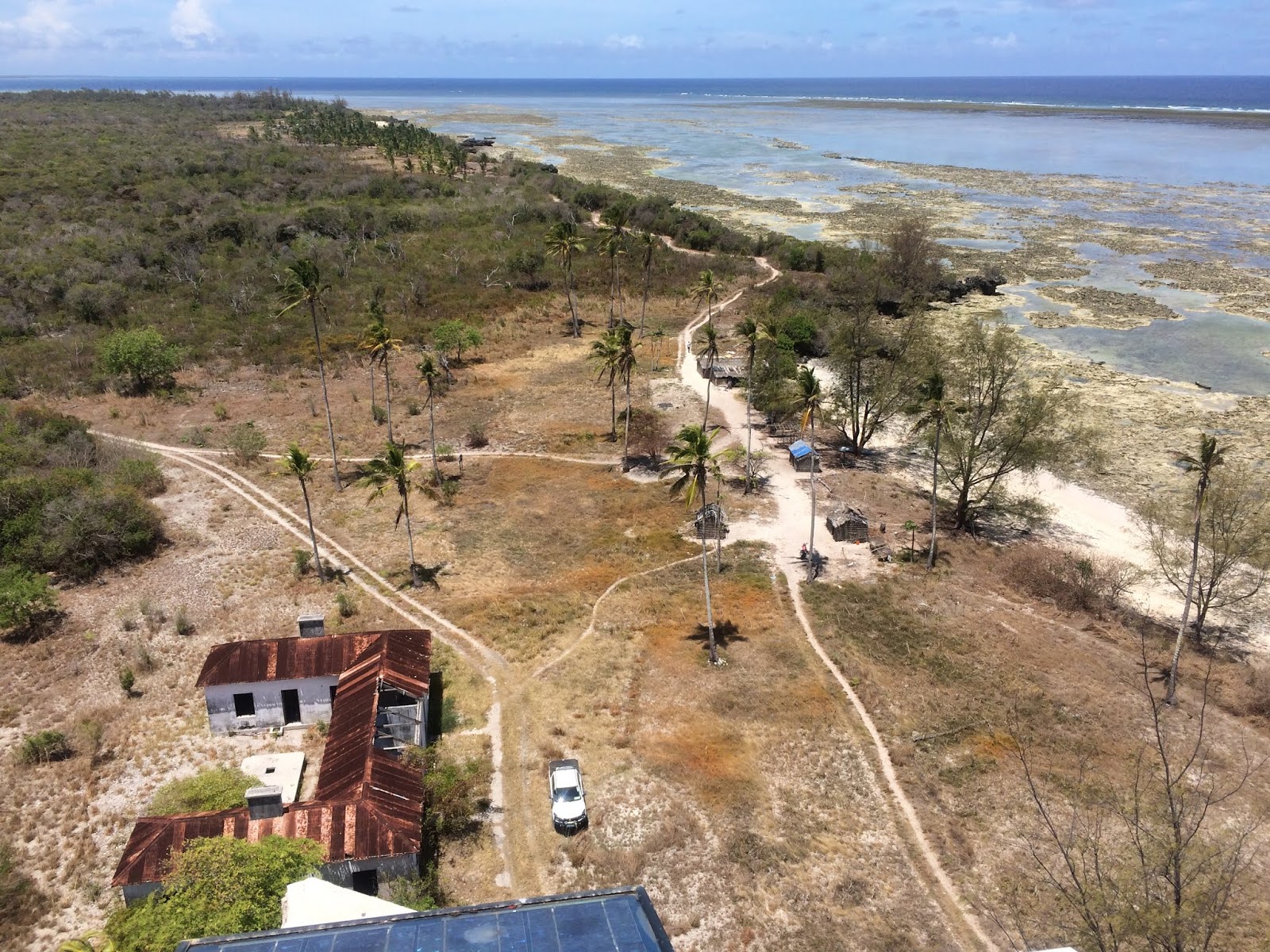
I've been in Mozambique this month, in the northern province of Cabo Delgado.  As part of the project I'm working on we went to visit a lighthouse on a rocky headland, where I came across an abandoned building that seemed strangely familiar.
As you may know, Mozambique was once a Portuguese colony and in fact they'd been present in the region since the sixteenth century or so, where one of the main 'exports' they were after was slaves.  And this reminded me of the tembe I made last year which would originally have been used by slave traders in that region.
The similarity with what I made last year and what I actually saw was therefore striking, even though this building was probably built last century as a guard house or similar.  Furthermore, the structure wasn't quite the same, as can be seen from the photo I took from the top of the lighthouse.
OK, so it has three sides instead of four but it looked pretty much the same from the front!  And by the way, here is the concrete lighthouse we climbed, which I have no plans to make.
It was 185 steps to the top and then a wooden ladder through a narrow hatch to get into the lantern.  Still, the views from up there were pretty good.
Oh, and Merry Christmas!

Saturday, 10 November 2018

Sheds

Clearly I'm on some sort of displacement activity spree (avoiding what exactly?) because I've made yet more buildings for the AK47 setting.  Although that said, these would not look out of place on any 20th century battlefield.
In this case it has been a couple of shed type buildings that I'd actually started a few years ago and finally got around to finishing.
For all buildings the construction was thin polystyrene pizza packaging with some fine corrugated cardboard glued on as appropriate
As in my previous post I added planking where required using wooden coffee stirrers cut up with a pair of pliers.  Everything was then undercoated in black.
For the woodwork I heavily dry-brushed those sections with dark earth (Revell 82) and then highlighted with dry-brushed sandy colour, using thin black wash to highlight shadows and so on.
For the corrugated areas I roughly painted them in a rust colour (e.g. Revell reddish brown 37) over the black.  On the walls I then added some pale blue (Vallejo Deep Sky Blue 70.844) and dry-brushed with sand and used some dark/black wash for shadows.
The second building started off with plain polystyrene walls but I upgraded it to have planking walls.  As I mentioned in my previous post I typically saw buildings like this in rural Gabon when I was there.
For this one the planking and walls were completed to a wood finish as previously; however, for the paler planking I daubed on some pale blue tester-pot emulsion [checks label, yes, it is called "Swedish Blue"].
Overall, I was quite pleased how that turned out so don't be surprised if you see the same effect tried in some future efforts I will then post about.

Sunday, 30 September 2018

Nice Bit of Planking

I've been making buildings again.  The idea was to construct some more structures for my 15mm AK47 Project, which I previously started by making a tembe and then a walled compound.
In this case I thought I'd draw on my observations of the types of buildings I'd seen in Gabon, when I was there on a project a few years ago.  In case you don't know, Gabon sort of sits in what I would describe as the armpit (or oxter, as we say in Scotland) of west Africa, south of Cameroon and Equatorial Guinea and north and west of the Republic of Congo (and beyond that, the Democratic Republic of Congo (DRC)).  Sweaty and humid it certainly is.
As with much of west Africa it is (or was) covered in forest and therefore wooden buildings are common; and because of the size of the trees the planks used can be very wide indeed.  In fact it was interesting being there to see felled trees with only the central trunk cut into planks and the rest of the tree just left there, presumably because it wasn't worth cutting up the rest of it.
Therefore, as wide planks are utilised in the real buildings, I realised that even at 15mm scale I could make use of those wooden stirring sticks I'm always collecting from coffee shops when getting my regular latte.
Construction was therefore bits of wooden stirring sticks cut to length using a pair of small pliers, with matches used to form the supports inside.  Normal wood glue (PVA) works great to stick everything together on a cardboard base.
Once dry, rough shelly sand was glued to the base and the building was undercoated inside and out in black paint (I have a tester pot of black emulsion I use for that).  The planking was then heavily dry-brushed with Dark Earth (Revell 82) and then lightly dry brushed with Afrika Braun (Revell 17).  Thin washes of black were applied to the lower walls and to emphasise shadows.
Although I'd intended these buildings for AK47, I did make them a slightly large 15mm scale because I do have a lot of 20mm figures in other periods.  I had also thought to make them modern African buildings by adding posters and things like corrugated iron but realised that by leaving them plain I could use them for 20mm ACW set-ups as well.
However, the other buildings I am making will be specifically for AK47 and this last one is aimed at that.  In this case it has some pieces of corrugated iron attached to it, made from corrugated cardboard with a narrow ridge spacing, that once covered, I believe, a set of annual accounts from Historic Scotland.
In addition, I made the roof look like it was made of thatching grass using the bristles cut from an old floor brush, these being natural fibres rather than nylon or something like that.  Painting was the same all over, except I treated the corrugated iron with a rust colour, followed by patchy colour (pale blue & off-white) and then some dry brushing to bring out the highlights.

Saturday, 2 September 2017

Takistan Compound

Since coming back from holiday I’ve been avoiding committing to the plastic/lead painting mountain for some reason.  This is, I know, associated with some deadline pressures at work (which I’ve missed anyway, which makes it worse in a way as the extensions just mean they haven’t actually gone away).  
But when that happens making and painting individual terrain pieces is what I usually turn to, and as noted in an earlier post I have been making various 15mm desert type buildings intended for AK47, ancients (DMB) or even Mexico.
Anyway, here is one of the pieces I’ve made, a compound that wouldn’t be out of place anywhere in Central Asia or Africa.  This is actually based on the examples you can find on the 'Takistan' terrain, originally part of the ARMA2 'mil-sim' PC game, now ported to ARMA3 (using the CUP mod, in case you're interested).
Clearly the terrain is supposed to represent Afghanistan, although maybe it is meant to be Tajikistan (or, heaven forbid, the unpronounceable Kyrgyzstan).
Modelling was my usual technique of cutting strips of thin pizza-base polystyrene which were then glued together onto a cardboard base.  Everything was painted a chocolatey earth colour and then fine sand was stuck to the walls (with PVA wood glue) and a coarser sand glued to the ground.   Walls were then painted in shades of sandy earthy colours with various washes to dirty them up.
Some static grass was added in various places and a tree put into one of the corners.  This is a piece of heather stem (we have a lot of it lying around in Scotland) with some of my home-made clump foliage stuck to the top.
I’ve a plan to make a whole forest of acacia trees using the bag of heather I collected a few years ago, but haven’t got around to it yet.  Overall, the compound turned out quite well and makes a contrast from the mainly white-walled 15mm buildings I also made, which I will post about later.
 
I may make a few more of these ‘Takistan’ type buildings but we shall see how much time, inclination and not to mention storage space, I have to do that.
Russian on the roof