Sunday, 14 July 2019

One-Hour Wargames 16: Advance Guard

This is the after action report (AAR) for the first game in the One-Hour Wargames Campaign that we started recently.  The idea was to begin with a neutral 'encounter' sort of scenario and see how it went from there.  For this game my freshly painted 20mm Napoleonic French (Italeri mainly) would be up against Geoff's Prussians.
The scenario allowed both sides to have six units and the objective was to be in uncontested possession of the central village after 15 moves.  For this game we used the One-Hour Wargames horse and musket rules, slightly amended. The book suggests that orders of battle be decided randomly.  Consequently starting forces looked like this:

French
3 x line infantry
1 x light infantry
2 x cavalry (dragoons)

Prussians
3 x line infantry
1 x cavalry (dragoons)
2 x artillery

As you can see from this, the French started with more infantry (including light infantry) and more cavalry than the Prussians, who were lumbered with two artillery batteries.  As we shall see, the lack of mobility, in what was suppposed to be an encounter battle, with both armies marching on to the table, doomed the Prussians from the start.
Scenario 16: Advance Guard
My plan was very simple: to advance my line infantry rapidly to the objective, using the cavalry to sweep round the open left flank (see map).  One of my infantry units would meanwhile hold the gap between the village and the wood to cover my light infantry into the wood on the right flank.  The plan worked perfectly.
French troops rushing the village
Cavalry to the left of me, infantry to the right
In fact the Prussians had barely got going before the French were already in the village and were beginning to threaten both flanks.
Prussians caught flat-footed
On the left, one unit of French dragoons immediately engaged the Prussian cavalry in hand to hand combat, whilst the other sneaked round the back of the melee to threaten the advancing infantry, forcing it into square.  In the centre the Prussian infantry stopped to fire at my troops in the village whilst another French infantry unit moved up on the left of the village.
Meanwhile, on the right my light infantry had advanced (very) rapidly and had managed to get into the woods without being intercepted.  Again the Prussian infantry had lined up opposite the French and started to engage in a fire fight.
From this point on things deteriorated very rapidly for the Prussians.  On the left after a few rounds of back and forth, the Prussians dragoons were defeated and the French dragoons then moved against the flank of the infantry facing the village.  Meanwhile the other dragoon unit had crossed the front and/or side of the square and charged the Prussian guns before they could bear, whilst the French light infantry in the woods had extended into line to engage the other Prussian battery from cover.
Not looking good for the Prussians frankly
The last blow of the game came when the French dragoons crashed into the flank of the Prussian infantry.  And there was nothing he could do about it.
Contact!
Neil Thomas' rules for horse and musked are quite brutal (to say the least) and the Prussians were swept away in one go.  And with the very real prospect of the adjacent Prussian line about to suffer the same fate, with the Prussians having basically no chance of getting into the village let alone taking control of it, that was the end of the game.
Endgame
Overall, the game was a frustrating one for the Prussians.  They were only able to deploy slowly because they had two artillery units and were deficient in cavalry.  The fact that the French got to move first, combined with the rapid movement rates, long shooting ranges and brutal outcomes from any sort of reverse, which define the OHW rules, meant that right from the start the Prussians were always going to have an uphill struggle to win.

On the other hand, it was an emphatic victory for the French and even more enjoyable because for most of my troops this was their first battle.  Perhaps it is true that the better the paint job the more likely one is to win, if I may say so myself (this thesis may require more research).

Anyway, with a win for the French the honour falls to me to choose the next battle and I have decided this will be #14: Static Defence, which will feature in the next campaign AAR.

Wednesday, 5 June 2019

One-Hour Wargames: Campaign

It's been a while since I posted anything but that doesn't mean I haven't been busy on the wargames front.

Having failed to have any wargames last year (sad, I know) I was determined for that not to happen this year.  Therefore I devised a simple campaign based on the scenarios in Neil Thomas's book One-Hour Wargames.


The idea was to make a straightforward branched campaign where one defined scenario would lead onto the next.  Bearing this in mind the only rules were that:
  1. the winner of each game could choose the next scenario from the following round or 'tier'
  2. the winner would also get to choose whether to be 'red' or 'blue' next time
  3. the winner would get to choose the rules used for the next game
  4. the choice of scenario would be limited (to a certain extent) by previous choices
The idea for these rules was to give some sort of structure and to reward whoever won each game.  
The scenarios used were selected by excluding ones we'd already played (see various AARs in this blog) and the ones I frankly didn't fancy, to get a shortlist.  These were then grouped into tiers on the basis of how (I thought) a typical campaign might play out.  There are 15 scenarios in the campaign (out of possible 30) and the position of each scenario in the branches was decided randomly by dicing.

The campaign is a Napoleonic one but that was just because I'd painted a lot of 20mm French (mainly Italeri, see various previous posts) over the last two years and wanted to finally get them on the table.
So far we have played one game (No. 16, Advance Guard), using a modified set of Neil Thomas' OHW (Horse and Musket) rules, and I won.  This is the only 'blunder into contact' type scenario in the campaign and seemed appropriate as a sort of neutral one to get the campaign going.  I will blog the AAR at a later date.

Having won the first game, I now have the choice of No. 14, Static Defence or No. 20, Fighting Retreat.  I haven't decided which one yet but I do know that the rule-set will be vanilla WRG 1685-1845.
The important thing is that whichever scenario is chosen limits the choices in the next tier.  So say I choose No. 14 this time, whoever wins (hopefully me) will get to select either No.18 or No. 13, but if I choose No. 20 next, the choice will be between Nos. 13 and 21, and so on.  So there is scope for a bit of planning and strategising (assuming I keep winning of course).

So, we'll see how this turns out and if it seems to work, I might very well adapt it for other scenario books I have, such as the excellent Scenarios for Wargames by Charles S Grant and/or Stuart Asquith's Scenarios for All Ages, or just make up some of my own.

Saturday, 5 January 2019

Customs Post

Customs (related to trading, as opposed to Yuletide) seems to be in the news of late, so what better way to celebrate this than to make a customs post?
This is for my AK47 collection and is actually an almost complete copy of a building from IrishSerb's blog, made in connection with his [checks website] on-going Mugabia-Uwanda War [OK, so not Ramsgate].  My approach to construction was similiar to his, i.e. practically the same.
For the customs building itself this was made using poor-man's foam board (pizza base polystyrene), which was pinned and glued together (I use Evo-Stik wood-glue for everything).  The bit of roofing over the 'serving hatch' and shutters made from corrugated cardboard were added, and a door was made at the rear from a piece of cardboard fixed inside the walls with some thin card panels attached to the outside.  Once the glue was dry everything inside and out was undercoated in black.
The walls were then covered in wood-glue and the building was dipped into a tub of fine sand to get most of the walls covered.  The sides of the building were painted using an earthy colour I use for mud-brick buildings. 
The areas of sand were then painted off-white (blue at the bottom), with smooth areas of wall (where there was no sand) left as bare 'mud', as though the plaster had fallen off.  The removable roof was made of corrugated cardboard, painted black and then rust colour.  Basing was my usual approach of coarse shelly sand painted dark earth and then dry brushed.
In addition to the customs post I made a small shelter for the sentries (I'd also started to make a swing barrier from a cocktail stick but then thought better of it).
The shelter was made from wooden coffee stirrers cut up with a pair of pliers, with sheets of fine corrugated cardboard laid over the top to form the roof.  Everything was undercoated in black and the wooden walls were then heavily dry-brushed with dark earth and the roof treated with a rust colour.
Further washed-out colours were added to the roof panels before the whole thing was lightly dry-brushed in a sand colour.  Basing for both models was completed with Javis static grass and some stick-on clumps of long grass.

Saturday, 29 December 2018

Hurrah and Hussar!

Just to prove I'm still capable of painting figures as well as making buildings, here are a few squadrons of French Napoleonic hussars I completed this month.
1st Hussars
These are Italeri French Hussars (#6008), which are very nice figures and easily match the dragoons I painted recently.  The figures come in a variety of uniform combinations, with some sporting campaign overalls, with or without pelisse worn or slung.
2nd Hussars
I decided to make six bases and paint each pair as a different regiment.  So, to get a variety of uniforms I settled on painting the 1st, 2nd and 6th regiments.  The box comes with 17 figures, so to make up the last squadron I had to add a figure from somewhere else to get to a round 18 figures and therefore six bases of three.
6th Hussars
The extra figure is wearing a busby, thus masquerading as an elite company trooper, and is actually the officer from the Italeri Guard Horse Artillery set (#6018), the rest of which may feature in a future post.

With these hussars, I'm nearly done with 20mm French Napoleonic cavalry, although I did get a box of Italeri French Light Cavalry #6080 (i.e. Chasseurs a Cheval) a few months ago, which as a cavalry type were more numerous and more commonly deployed than hussars.  So I may get around to painting them next year, once I've got a few other projects out of the way first.

Tuesday, 25 December 2018

When Life Imitates Art

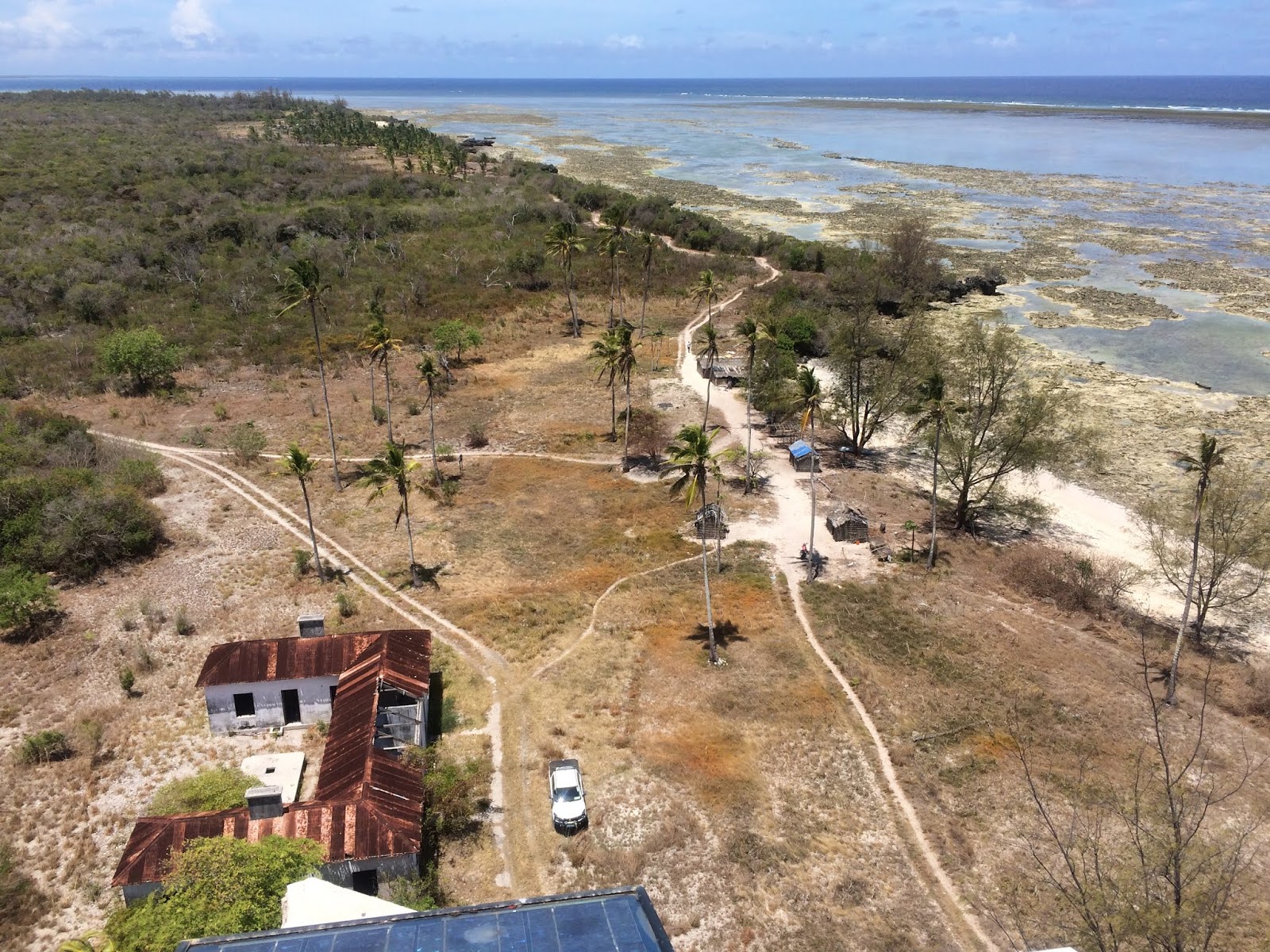
I've been in Mozambique this month, in the northern province of Cabo Delgado.  As part of the project I'm working on we went to visit a lighthouse on a rocky headland, where I came across an abandoned building that seemed strangely familiar.
As you may know, Mozambique was once a Portuguese colony and in fact they'd been present in the region since the sixteenth century or so, where one of the main 'exports' they were after was slaves.  And this reminded me of the tembe I made last year which would originally have been used by slave traders in that region.
The similarity with what I made last year and what I actually saw was therefore striking, even though this building was probably built last century as a guard house or similar.  Furthermore, the structure wasn't quite the same, as can be seen from the photo I took from the top of the lighthouse.
OK, so it has three sides instead of four but it looked pretty much the same from the front!  And by the way, here is the concrete lighthouse we climbed, which I have no plans to make.
It was 185 steps to the top and then a wooden ladder through a narrow hatch to get into the lantern.  Still, the views from up there were pretty good.
Oh, and Merry Christmas!

Saturday, 10 November 2018

Sheds

Clearly I'm on some sort of displacement activity spree (avoiding what exactly?) because I've made yet more buildings for the AK47 setting.  Although that said, these would not look out of place on any 20th century battlefield.
In this case it has been a couple of shed type buildings that I'd actually started a few years ago and finally got around to finishing.
For all buildings the construction was thin polystyrene pizza packaging with some fine corrugated cardboard glued on as appropriate
As in my previous post I added planking where required using wooden coffee stirrers cut up with a pair of pliers.  Everything was then undercoated in black.
For the woodwork I heavily dry-brushed those sections with dark earth (Revell 82) and then highlighted with dry-brushed sandy colour, using thin black wash to highlight shadows and so on.
For the corrugated areas I roughly painted them in a rust colour (e.g. Revell reddish brown 37) over the black.  On the walls I then added some pale blue (Vallejo Deep Sky Blue 70.844) and dry-brushed with sand and used some dark/black wash for shadows.
The second building started off with plain polystyrene walls but I upgraded it to have planking walls.  As I mentioned in my previous post I typically saw buildings like this in rural Gabon when I was there.
For this one the planking and walls were completed to a wood finish as previously; however, for the paler planking I daubed on some pale blue tester-pot emulsion [checks label, yes, it is called "Swedish Blue"].
Overall, I was quite pleased how that turned out so don't be surprised if you see the same effect tried in some future efforts I will then post about.

Sunday, 30 September 2018

Nice Bit of Planking

I've been making buildings again.  The idea was to construct some more structures for my 15mm AK47 Project, which I previously started by making a tembe and then a walled compound.
In this case I thought I'd draw on my observations of the types of buildings I'd seen in Gabon, when I was there on a project a few years ago.  In case you don't know, Gabon sort of sits in what I would describe as the armpit (or oxter, as we say in Scotland) of west Africa, south of Cameroon and Equatorial Guinea and north and west of the Republic of Congo (and beyond that, the Democratic Republic of Congo (DRC)).  Sweaty and humid it certainly is.
As with much of west Africa it is (or was) covered in forest and therefore wooden buildings are common; and because of the size of the trees the planks used can be very wide indeed.  In fact it was interesting being there to see felled trees with only the central trunk cut into planks and the rest of the tree just left there, presumably because it wasn't worth cutting up the rest of it.
Therefore, as wide planks are utilised in the real buildings, I realised that even at 15mm scale I could make use of those wooden stirring sticks I'm always collecting from coffee shops when getting my regular latte.
Construction was therefore bits of wooden stirring sticks cut to length using a pair of small pliers, with matches used to form the supports inside.  Normal wood glue (PVA) works great to stick everything together on a cardboard base.
Once dry, rough shelly sand was glued to the base and the building was undercoated inside and out in black paint (I have a tester pot of black emulsion I use for that).  The planking was then heavily dry-brushed with Dark Earth (Revell 82) and then lightly dry brushed with Afrika Braun (Revell 17).  Thin washes of black were applied to the lower walls and to emphasise shadows.
Although I'd intended these buildings for AK47, I did make them a slightly large 15mm scale because I do have a lot of 20mm figures in other periods.  I had also thought to make them modern African buildings by adding posters and things like corrugated iron but realised that by leaving them plain I could use them for 20mm ACW set-ups as well.
However, the other buildings I am making will be specifically for AK47 and this last one is aimed at that.  In this case it has some pieces of corrugated iron attached to it, made from corrugated cardboard with a narrow ridge spacing, that once covered, I believe, a set of annual accounts from Historic Scotland.
In addition, I made the roof look like it was made of thatching grass using the bristles cut from an old floor brush, these being natural fibres rather than nylon or something like that.  Painting was the same all over, except I treated the corrugated iron with a rust colour, followed by patchy colour (pale blue & off-white) and then some dry brushing to bring out the highlights.

Wednesday, 19 September 2018

Claymore 2018

Right, I know this is remarkably late and despite it already being mid-September by the time I'm getting round to writing this, it has to be said that the first week in August wouldn't be the first week in August within a visit to Scotland's premier wargame show, Claymore.
East Neuk Irregulars - Anglo-Iraq War 1941
Every year I marvel at long we've been coming to Claymore (since 1979 I think: estimates vary) and also how fashions and interests change.  For example this year there were no Very British Civil War (VBCW) games on at all, but then perhaps as something similarly pointless and costly is playing out inexorably in British politics at the moment, there's a reason for this.

Anyway, to the games and the ones that caught me eye (and/or could photograph before my phone filled up).  First up is Gourock Wargames Association and their D-Day Orne River Bridge game.
Getting the Orne just looking at this frankly.
I'm always impressed when a terrain piece is scratch-built and/or purchased that is so recognisable that it can only be used for one scenario.  That's dedication.  Then there was the Carry On Up the Khyber participation game (Leuchars Veterans) that looked quite good.
Just waiting for the Khazi of Kalabar to arrive.
One of my favourite Carry On films that, particularly the dinner party scene.  Also Terry Scott (Sgt MacNutt) asking Charles Hawtree (Pvt Widdle) what he was doing painting a red line across the compound "That's t thin red line - they'll never get past this!" "Widdle, if you don't get out of here, I'll paint a thin red line across your thick white backside!"  Ah classic stuff.

Another interesting one was the Iron Brigade's Napoleonic game, supposed to be a Seven Years War battle (Zorndorf?  I didn't write it down) so with Russians fighting Prussians.  I was confused by that at first.
Prussians v Russians
Finally in the 'atrium', there was an interesting one put on by Supreme Littleness Designs / University of Edinburgh.  This was a siege of Byblos crusader castle in Lebanon, which was billed as "wargame terrain and scenarios design meets academic research".
Byblos Castle
The idea was that this would be a fusion of game design, which is of course a 'big thing' at the moment, and no doubt subject to academic study itself, and the findings of medieval historians, one of whom (from Edinburgh University) was there to talk to (very interesting guy).  I was particularly interested because I had actually been to Byblos in 2001 so I knew what he was talking about.  Further information on the project can be found here.

Moving on to the main hall, I was impressed with East Neuk Irregulars' (they're from Fife) Anglo-Iraq War 1941.  I like the silver biplanes from that period especially.
Nice.
Staying in the main hall, the prize for the longest game (dimensionally) went to Chris & Pat Brown / Aberdeen Wargames Club with their Road to the Reich game.  I couldn't quite get it all into one shot.
I'm tired just looking at that
Other games included 'T in the Park' (Berlin 1945) by Kirrimuir Wargames Club that was getting an official prize of some sort at one point (best game?).
Russian tourists invade Berlin
That Reichstag got a fair old battering before and after the war didn't it.  Finally, there was the Suez 1956 game put on by the very friendly Gottenburg Gamers.
East of ... where was it again?
It was a participation game but we just chatted to one of the gamers (I forgot his name).  What was sorted out was that they weren't actually from Gottenburg or indeed Swedish, but were actually from East Lothian (near Edinburgh) and based in a pub called The Prestoungrange Gottenburg.  I think some of them were ex-SESWC.

So overall, another good year and I hope that I'll get more posts done in the months before August comes round again next year.