Showing posts with label Books. Show all posts

Saturday, 29 April 2017

The Weather Where You Are

Geoff got me an ex-library copy of Charlie Wesencraft's classic Practical Wargaming a few years ago.  It was one of those books we used to take out of Edinburgh Central Library on a regular basis (my copy is from the Lancashire County Library, first borrowed in March 1975, with the last date stamp being 27 Feb 2008.  Nobody needs to know that but I thought I'd record it anyway).
However, not just being a trip down memory lane the book does actually have some interesting ideas in it, not to mention some arresting expressions.  The one I always remember in the discussion about missile fire is that we are not supposed to be interested in whether a particular infantryman 'successfully stops an arrow with his chest', a phrase which I still find funny, if a little macabre.
Fun with hardboard and paint
Anyway, in the Preparation for Battle chapter, there is a discussion of the effects of weather on battles and instructions on how to make and use a weather 'barometer'.

The illustration from the book explains how it is used, which is basically to throw 2D6 at the start of the game to find a starting point between '2' at the top (fog) and '12' (storm) at the bottom and then move the red peg up or down (or not move it at all) depending on die throws each move.
Weather barometers and funk boards: the epitome of 1970s wargaming
As you can see I added an extra section at the top, which is not actually part of the barometer but where the string goes so I can hang it up.

So it will be interesting using this in our next game.  However, I would like to add that, based on a Scandinavian book I had as a child (I still have it), the word 'barometer' is inextricably linked with the word 'foreboding'...

Wednesday, 18 June 2014

This Week, I Have Been Mostly Reading...

...Magazines.  Well things are moving again, sort of, in that I've been doing even more reading.  I don't often buy wargame magazines these days (infested as they often are with too many space marines, zombies and in-your-face marketing) but here are the latest ones I've been looking at.  First up is Wargames Illustrated #314 from, what?  Is it really December 2013?  I'm really falling behind...
Anyway, this one featured the War of the Spanish Succession (WSS), which is this decade's new period for me.  Lots of nicely painted figures and an excellent overiew of the war as well as accounts of various WSS battles, including Blenheim (obviously) as well as one that Marlborough wasn't at (Cassano, northern Italy 1705) all very enjoyably written by Simon MacDowall of the Legio Wargames website and blog.  And all this plus an article on Jutland and some ACW stuff and only two pieces relating to Flames of War products, so I think we got off lightly there.

Then there was the impulse buy this weekend.  We had to try out Edinburgh's new tram and so we ended up in the Gyle Shopping Centre and, with nothing much to do whilst my son was engrossed in his Godzilla 'zine, I bought Minature Wargames #374.  The principal motive was that it has an article by Dr Kerry Thomas on mass painting of 15mm horses, which I often find difficult.  And what with quite a few WSS Blue Moon 15mm cavalry to paint (as Danes) I needed some ideas and inspiration.  Job done.
A bit more variety here though, it has to be said, particularly with an article on Chotusitz 1742 (War of the Austrian Succession) which isn't quite WSS but is in the right half of the appropriate century for me these days.  There is also something on the first part of an 18th century campaign system that looks promising (although to get the full flavour it appears that it may be necessary to purchase one or more of the Age of Absolutism books from Caliver).  I will draw a veil over the fantasy/futuristic product reviews and the new boardgaming columnist and all those hexes and dull cardboard counters.

I should add that I have never thrown out a wargame magazine in my life and therefore I was also able this week to pull off the shelf and review this timeless classic, Minature Wargames #1.
Well do I remember as a Glasgow University student walking by a newsagents on Byres Road in 1983 and seeing this and rushing in immediately and buying it (for 75p).  I could not believe that there was an actual real wargame magazine in print!  And it's a classic too, with articles by George Gush, Paddy Griffiths, Phil Barker, Terry Wise, Ian Weekley (always with the qualifier "of Battlements" lest he be confused with any other bearded Ian Weekleys out there) and of course good old Duncan Macfarlane, WI's first editor.

The thing is that I didn't remember that it included a guide to painting 15mm figures and a (free) futuristic space strategy game to be played out on a hex map.  Isn't it funny how some things don't change.

Monday, 21 April 2014

Battle Notes for Wargamers

As a wishful wargamer, some might say an almost entirely virtual wargamer, I tend to spend most of my time musing on and vaguely planning wargame projects, rather than actually getting any gaming done.  This is mainly because of that old issue of time, which is particularly relevant at the moment because I am about to go off on two consecutive two-week business trips, the first one to Uganda (again) and the second to Uzbekistan (again), so I won't even be near getting back into the saddle until late May.

Wargame books are therefore a very important way of staying connected to the hobby (and my own nostalgic take on it) and when I'm on the internet browsing for things, the 'classics' are the ones that I am invariably drawn to, even if I've not read them before.
Main map for the St Nazaire raid (hand tinted).
In this regard finding a copy of Donald Feathstone's Battle Notes for Wargamers on eBay for £2.99 last week was too much of a bargain to resist.  The copy I received was in very good condition, apart from a bit of spotting on the fly-leaf (oo-er) and the fact that some previous owner has carefully coloured in some of the maps.  Still, for £2.99 it's value for money.
Detailed map for St Nazaire raid.
The book is basically a series of wargame scenarios based on real battles through the ages, stretching from Pharsalus in 48BC to the (Korean War) Pork Chop Hill in 1953.  Of particular interest to me are the Battle of Wynendael (1708) part of Marlborough's campaigns in the Low Countries and the St Nazaire Raid (1942) featured here.

For each scenario there are two maps, comprising a sort of strategic map and a detailed table top map that can be used for the wargame.  The scenarios also include various rule ideas, what ability commanders should have, how to inject the element of surprise (not telling the players what battle it is seems to be the simplest method), tips for making terrain and other ways to game the scenario specifics for each battle.
Overall it is a worthwhile book to have if you are interested in scenario ideas and it complements the excellent Scenarios for Wargames (1981) by Charles S Grant, which provides 52 fictitious scenarios to fight though based on various wargame problems. I understand that John Curry has an updated and revised version of Battle Notes in print currently.

Tuesday, 12 February 2013

Armies and Uniforms of the WSS (Vol 2)

As with all my various wargame projects, which as you may have noticed always have incredibly long and overlapping timescales, I am laying the ground by buying books, reading widely, and speculating imaginatively what it would be like to paint and then wargame with such and such an army, before moving egregiously on to the next period. I’ll run out of periods soon.

However, it is fun to collect good books; and we should be thankful that there continues to be a growing interest in wargaming with many excellent wargaming books (and rule sets) constantly being produced. Below is my latest purchase, which was an obvious addition after recently buying Vol 1 from the excellent Caliver Books (see earlier post below).
Right lads!  Don't fire until you see the whites of their....er....cravats?
If you only have the first volume I would heartily recommend getting this book as well. Not only has it twice as many plates as the previous book, but it also describes the war in more detail and rounds out the narrative with more information on actions in Spain and Italy (including the involvement of the Papal states).

The main thing though is that it gives a lot of detail on Spanish armies (of both sides) as well as the armies of Portugal, Savoy/Piedmont plus additional plates covering British and French uniforms that apparently couldn’t be fitted into the first book. There are also some details of the main battles in Spain and Italy and of course the well known engagements in the Low Countries.

This book therefore is an essential purchase for me because although my intention is, for the first time, to build an army of redcoats (and supporting Dutch) to (one day) face Geoff’s (Roundway) French, I think it will be interesting to build up a Spanish army, as they were an effective fighting force, often deployed with French allies, sported some colourful uniforms and also had the opportunity to fight over some pleasant Iberian terrain. Which can’t be bad.

Sunday, 3 February 2013

Books of the War of the Spanish Succession

A couple of books arrived this week, one from Amazon and the other from Caliver Books.  Geoff has been slowly building up a French army for this period using Roundway figures and I had not really paid much attention to it, until now.  So, I thought I'd get a few books on the period to see how it went (I have form in that direction).

Actually Steve the Wargamer's WSS project pages have provided very useful information (including comparisions between different figure manufacturers) and pointed me in the right direction.  The first was the David Chandler book The Art of Warfare in the Age of Marlborough, which is mainly about organisation and tactics although it does list every engagement in an Appendix (not bad second hand for £10 plus p+p).
The other book that arrived was CS Grant's Armies and Uniforms of Marlborough's Wars Vol 1.  This is an excellent book with very fine illustrations mainly by Bob Marrion and includes comprehensive tables of coat colours and facings for what appears to be all of the regiments of Austria, Bavaria, England (Britain after the Treaty and Acts of Union of 1707, technically), Denmark, the Netherlands, France and Prussia.
It all looks very interesting although I'd hoped that Spain would be included in this book (I've never had any Spanish troops, nor fielded the redcoats for that matter).  However, puchasing Vol 2, to get information on the Spanish armies as well as other minor states, will be no hardship if it is as good as this volume, I think.

Monday, 20 August 2012

Seven Years War Project No.1

I've been considering this for a long while and I think things are getting closer to fruition, in other words the commencement of a new period.  As usual I do a lot of planning and reading (for years sometimes) before ordering figures and getting started - mainly because I'm not that motivated when it comes to painting.  However, the SYW has been floating around in my mind, particularly since I read (and am currently re-reading) Franz Szabo's The Seven Years War in Europe (published by Longman, 2007).
I'd really recommend this book, well, for a number of reasons, although mainly it's because it's fairly recently published and has drawn on a lot of original sources in German: Szabo being a Canadian of Austrian extraction.  This latter point is of note because he is no apologist for Frederick the 'Great' and in fact sticks the boot in with gusto (occasional comparisons with the approach to foreign policy shared by Prussia and the Third Reich do not seem out of place in fact).

Some critics (for example on the TMP 18th century forums) ascribe this to Szabo's Austrian roots and desire to promote Austrian successes, but the account I think is more accurate and more critical than previous historians and times have allowed, where the supposed greatness of Frederick and his military 'genius' have been exaggerated either for political reasons or simply because a full and objective review of the primary sources was not previously available to scholars.

The Szabo book just covers Europe (as though that's not enough to be getting on with) but I was interested in what was happening elsewhere, so I also got Daniel Baugh's book, The Global Seven Years War (also Longman, 2011).
I've not read it yet although it looks interesting (and we get two extra years thrown in!).  I'm hoping it will cover some of the more interesting actions in the colonies (and not just North America) and I think there'll be a lot on naval engagements too.

Finally, I should add that not content with reading about the Seven Years War, I thought I needed a bit of background reading and in fact today received this nice hard-back copy of Reed Brown's The War of the Austrian Succession (St Martin's Press, 1993), from a second hand bookshop in America (via Abe Books), and hence the prompt to post something about it all.
There are more recent books on the WAS (1740-1748) but Szabo recommends the Reed Brown book in a footnote early on in his tome and then mentions in passing that, oh yes, there's also something in the Longman's Modern Wars in Perspective series by Anderson (damned by faint praise).  So yes, plenty of inches to wade through.

Thursday, 5 July 2012

D Hewins of Grimsby

Apologies for the long hiatus since I last posted but I've been away in various places recently: some interesting and others... not so interesting.  I will concentrate on the former.

I'm not that well travelled in certain parts of England, being from North of the Border, but a current project at work (relating to offshore windfarm developments in the North Sea - there'll be 5,000 turbines on the Dogger Bank in 10 years, mark my words) has recently brought me to Hull, Scunthorpe and lastly Grimsby.  Of these, I was pleasantly surprised by Hull; Scunthorpe I didn't see much of and Grimsby I was a bit worried about until I discovered a gem: D Hewins Models and Hobbies at 7b East St Mary's Gate, unprepossessingly tucked away in a narrow brick courtyard behind an Italian restaurant. (It has no website).
I have to say that although it was well hidden ("You found us though," said Mr Hewins (I presume that it was he)) it was well worth it.  I love shops like that packed from floor to ceiling with models, books, soldiers, and yes, even railway stuff.

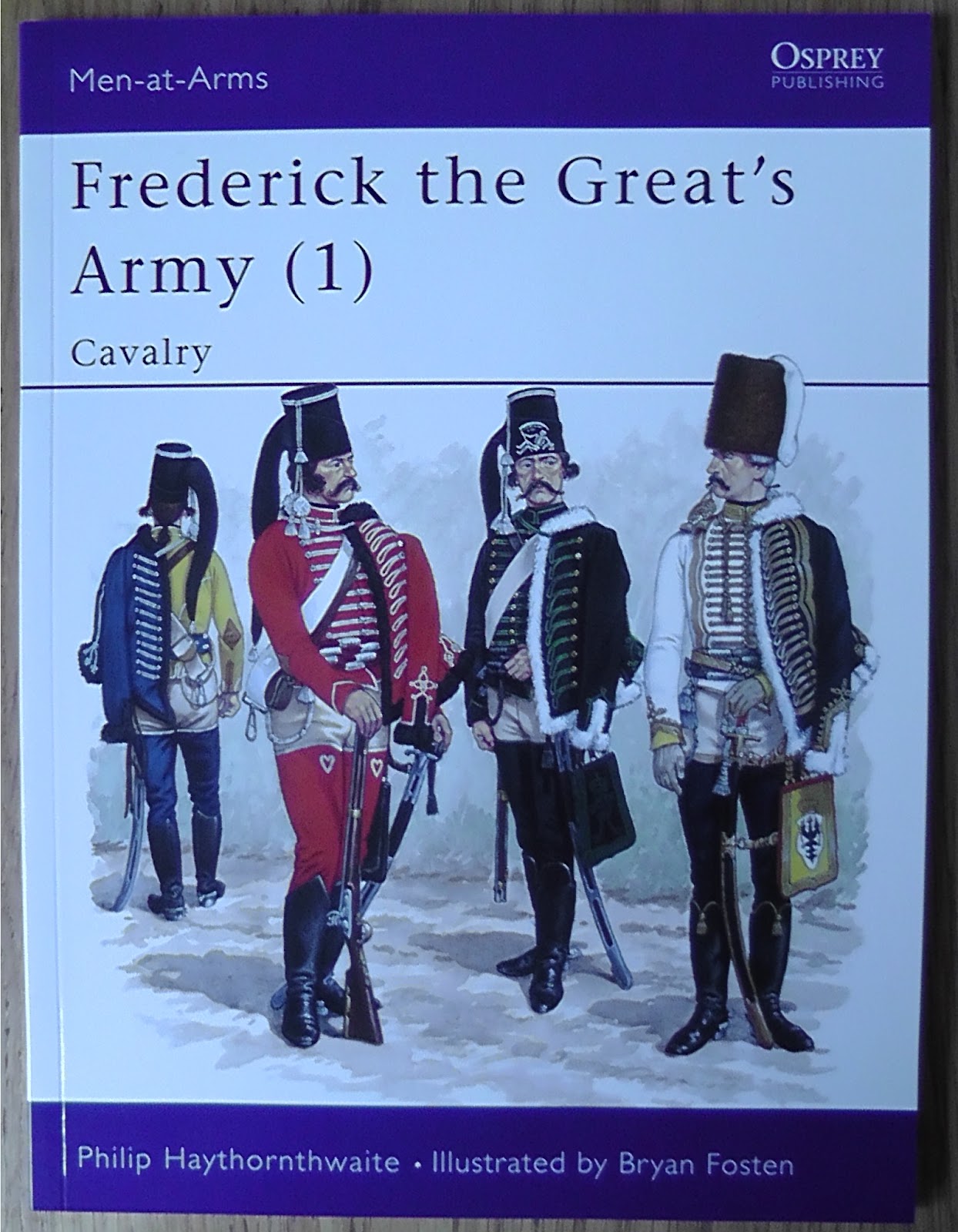
The great thing was that I found something that I'd been looking for for ages, which for some reason I had not been able to get hold of easily (or at least reasonably priced - perhaps it is out of print?): the Osprey Frederick the Great's Army (1) Cavalry.
Not that I have much in the way of Seven Years' War stuff, but it is an interest floating around somewhere.  There were a couple of other finds which I may blog about later (the 3 for 2 offer got me).  The things is, the proprietor clocked me for a wargamer right away, raising an eyebrow at my eclectic choice of books covering WW2, the SYW and the Crusades.  Well, I am the Wishful Wargamer, after all.

Anyway, a highly recommended shop and if you're in the area you should drop by and say the Wishful Wargamer sent you.  He won't remember me but he may recall the bald guy in the suit a couple of weeks ago with the massive suitcase barging about his shop grinning, and about to head off to Romania.....

Saturday, 19 November 2011

In Praise of WRG

Having finally gone with the flow and ordered a copy of Black Powder (a while back now but, well, if Angus Konstam says it's OK then it must be) but having yet to try them out on the battlefield, I felt the urge to look though some of the rules still on my shelves.

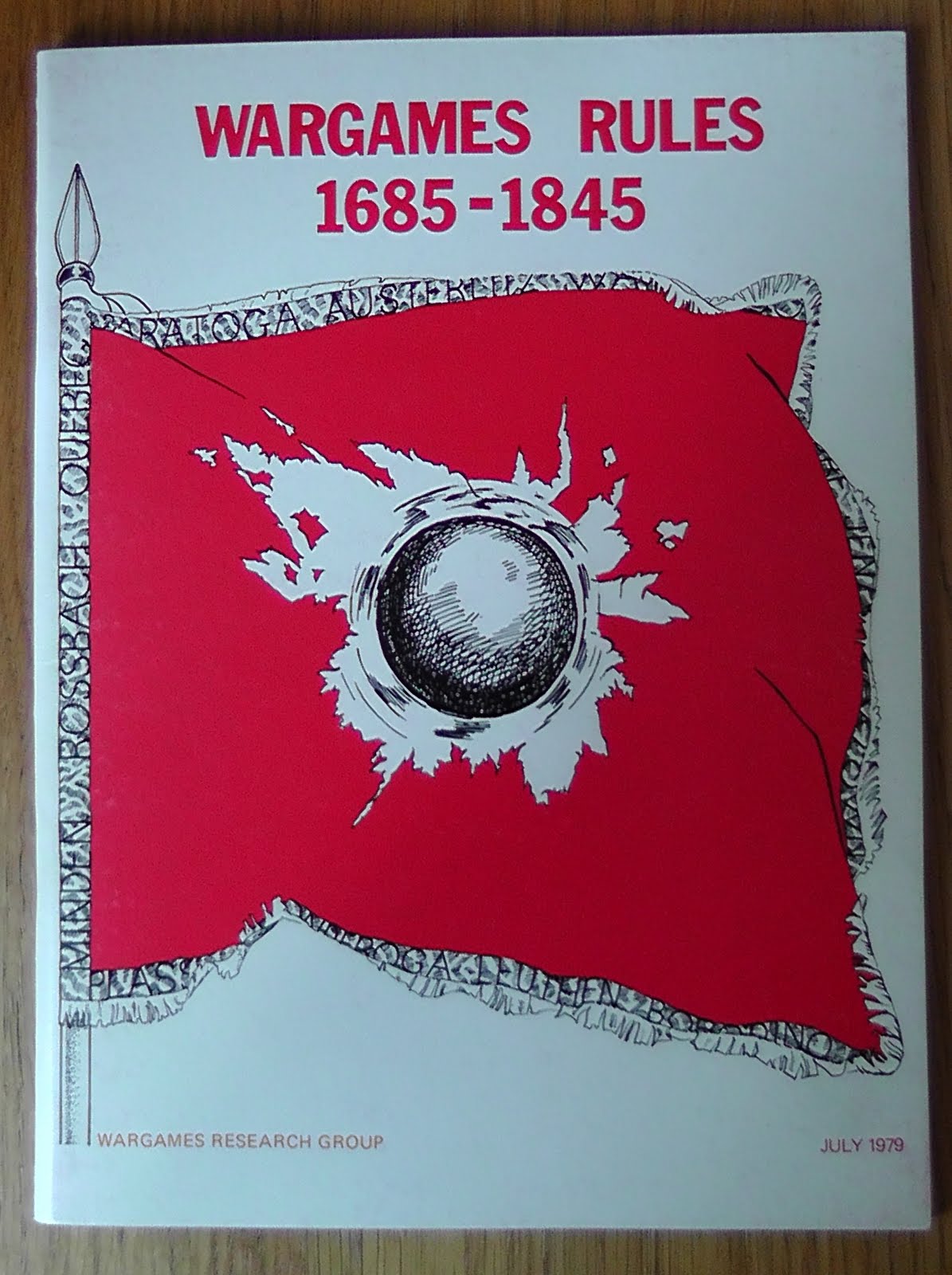
Despite my recent purchase(s), and a backlash in some quarters against slick overproduced wargames rules with nice graphics and must-buy supplements, I fall somewhere in the middle ground.  I'm not so extreme that I want to to back to Charge! or Charles Grant (I still find Don Featherstone useful though) but I do have a soft spot (some would say 'penchant', well they would, wouldn't they?) for the good old WRG rules.  I mean what's wrong with a little complication and precision?  Some examples of the might of WRG from my collection (in historical order):
Ah, the 6th edition.  Anyone one still play it?  I never did - I just include it for reasons of completeness.
George Gush's classic set of rules.  Beats Tercio into a cocked hat.  Probably.
What's not to like?
I should have persevered with this one more that I did....
I bought this after playing Operation Flashpoint and ARMA on the computer.  It's a bit more complicated though.

WRG buffs will note that I've not mentioned DBA, DBM and DBR although these I think are of a later vintage and we've had many a good game with them too.  But, things have moved on and it looks like my line up of favoured rules is shaping up like this:
  • Regimental Fire and Fury (and Fire and Fury) - so popular it must be good (the RF&F book is lovely)
  • Black Powder - for 18th and early 19th century - ditto.
  • WRG 1685-1845 - old habits die hard.... and the turn sequence seems perfectly logical to me...
  • Principles of War 2nd edition - never played it but I really like the command system.
As for earlier periods I intend to persevere with DBM (not convinced by FOG) and I've never really tried DBMM.  Even DBR finds favour in this establishment (just for some 1/300 ECW).  So much choice, so little time...

Monday, 22 August 2011

Black Powder

Aside from adventures in basing our old ACW armies (I'm about halfway through doing the Union army), I've been reading a few things including Black Powder, which arrived safe and sound from Amazon last week.
The rules have been reviewed a fair bit in various places so I'll not say much more here, other than so far I've found them enjoyable and interesting to read.  I like the command constraints mechanisms they offer, for example, although I might adopt some of the house rules out there after reading the discussions on the BP Yahoo group.  I may also put down some of my thoughts on the rules once we've played them a few times.

However, I have to say that they did grab me straight away with the faux pompous style (at least I hope it's faux) and in fact there is quite a bit of humour throughout: even the 'Black Lung' cigarette cards on the front are faintly amusing.  I expect such cards come with the cigars one is supposed to puff on furiously whilst playing in the billiard room.

So, some play testng in the offing, I predict, perhaps even with the ACW troops I'm re-basing...

Friday, 5 August 2011

Wargaming Airborne Operations

I've had a copy of this 1977 Donald Featherstone book for a few years but the last time Geoff was round he expressed an interest in it, and as we've been in WW2 skirmish mode recently, I managed to get a copy for him from ebay (it's his birthday).
It's another one of those classics with lots of exciting pictures of barely or even unpainted plastic figures, paratroop drops using bits of tissue paper tipped out of a box and brilliant cardboard cutout gliders (that really glide!).  Such a contrast from today's slick presentation and requirements for this season's models and rule supplements (I digress).

Also, if you notice, every word of the book's title on the dust cover has a hyphen in it, which is quirky, to say the least.

Anyway, using the ideas in this book we have very successfully re-fought the D-Day landings and Operation Market Garden (And Crete?  I can't remember).  I even have a model of the Arnhem bridge in 1/72 scale somewhere...
...which looks remarkably like the one featured on pages 146-150 of the book.

Wait a minute.  Three posts in a row about books?  What's going on here?!

Saturday, 30 July 2011

Spanish Colonial Fortifications

I'm keen on making things for the wargames table and that usually means buildings (see previous posts), particularly structures that you might find in desert or arid environments.  Maybe it's because I'm from Scotland that I need a bit of simulated warmth now and then (I also lived in Granada for a while, which is probably the real reason).

Anyway, Spanish American buildings are one of the lines I'm interested in as I have a long term aim to wargame the Maximilian expedition in 15mm.  Furthermore, any such buildings may come in handy for Africa (AK47) and the ancient middle east (Lydia/ Persia).  Hence my latest purchase from Osprey:
And you know it's not just the Alamo in there, but lots of opportunities for interesting colonial interactions in the 18th century (or earlier) as well.  That said, I will of course still be relying on The Magnificent Seven for ideas on Spanish American architecture and ambience (not to mention Rosenda Monteros).

Saturday, 11 June 2011

Matilda on the March

This Commando book (No. 933) from 1975 has haunted my dreams for years - until I found it on ebay not so long ago.  It was reprinted in 1989 (as No. 2259), apparently with the same cover.  I know, slightly too much information but, well, it is a classic.
It is also still an inspiration for all the various bits of desert terrain and (admittedly) Afrika Korps resources I've built up.  And I also like the cover with the interesting low level light source silhouetting the Germans and highlighting the Matilda (and the grenade).  In the book the dialogue goes "Was ist das?"  as the grenade sails into the Kubelwagen followed by "Gott in Himmel!" and "Argh!" as it goes off.

Saturday, 7 May 2011

The Rules With No Name

Not really a post about Wild West gaming but rather a plug for TRWNN.  One of the reasons I bought a copy recently, after having had the free version knocking about for some time, was the painting guide it contains.
I'm not that used to painting figures larger than 15mm so I felt I needed a straightforward guide to shading and what-not, and TTRWN completes the double whammy by not only being a darn good set of rules but also by including a very clear guide on painting the Wargames Foundry way!  I'm trying to use these techniques on my Darkest Africa figures (without shelling out for the WG paint system of course).  Need to practice though....