Showing posts with label French. Show all posts

Saturday, 16 May 2026

Chasseurs à Pied

In addition to the ongoing development of my early Napoleonic Russian and matching Württemberg armies in 15mm, I also have quite a few plastic 20mm French, mainly for historical reasons. However, some of these saw action in the first game of our One-Hour Wargames mini-campaign.

HäT Industrie - Guard Chasseurs à Pied

Nevetheless, one thing I didn't have was any guard units (apart from some Italeri Guard artillery).  That said, I do still have the contents of a box of old Airfix Grenadiers of the Imperial Guard but, although they are nice sculpts, they are quite small compared to the other units I have which are mainly Italieri now (although with some legacy Airfix units still knocking about) and not worth painting.  I also like to have units in marching poses if I can, so these HäT Industrie (8170) Guard Chasseurs à Pied were ideal.

More of same

There are (I think) three marching-ish poses in the box and enough to make a unit of 15+1 men, when based for the WRG 1685-1845 rules (60mm wide bases).  However, for some reason an officer is not included in the box, so the chap in the front rank brandishing a sword is a converted Italeri Guard foot atilleryman promoted from the ranks to regimental commander.

Overall, they are nice sculpts and are similar in size my Italeri line units.  They also match in style and quality my average painting abilities (but slightly better basing skills).

Tuesday, 21 October 2025

Russians and French

I'm still expanding my 15mm Napoleonic Württemberg army, and intend to add more now that, at the time of writing, Warrior Minatures has commenced trading again (urrah!).

Russian Uhlans (Polish), Warrior Miniatures

In the meanwhile, here are some Polish and Tartar Uhlans in Russian service I finished recently.  

Russian Uhlans (Tartars), Warrior Miniatures

They can be difficult to distinguish, except that the shabraques are different and the Polish penant is blue above red, whilst the Tartar penant is the other way up, although the Tartars do also have red czapkas.

French Dragoons, Warrior Miniatures
The Württembergers also got some French allies, in the form of a regiment of dragoons.  These will eventually be supplemented by some French infantry, this time from Magister Militum, bought, sadly, in their closing down sale (whilst Warrior was offline).

Artillery limbers, Warrior Miniatures
Finally I have some artillery limbers.  These are actually Warrior ACW limbers, normally with two horses, which I modded slighly and then added more horses.  I painted them as Russian artillery, but they could be used for anything really.

Next up will be some more Württemberg cavalry and probably the French infantry, but I need to get around to painting them first.

Sunday, 14 July 2019

One-Hour Wargames 16: Advance Guard

This is the after action report (AAR) for the first game in the One-Hour Wargames Campaign that we started recently.  The idea was to begin with a neutral 'encounter' sort of scenario and see how it went from there.  For this game my freshly painted 20mm Napoleonic French (Italeri mainly) would be up against Geoff's Prussians.
The scenario allowed both sides to have six units and the objective was to be in uncontested possession of the central village after 15 moves.  For this game we used the One-Hour Wargames horse and musket rules, slightly amended. The book suggests that orders of battle be decided randomly.  Consequently starting forces looked like this:

French
3 x line infantry
1 x light infantry
2 x cavalry (dragoons)

Prussians
3 x line infantry
1 x cavalry (dragoons)
2 x artillery

As you can see from this, the French started with more infantry (including light infantry) and more cavalry than the Prussians, who were lumbered with two artillery batteries.  As we shall see, the lack of mobility, in what was suppposed to be an encounter battle, with both armies marching on to the table, doomed the Prussians from the start.
Scenario 16: Advance Guard
My plan was very simple: to advance my line infantry rapidly to the objective, using the cavalry to sweep round the open left flank (see map).  One of my infantry units would meanwhile hold the gap between the village and the wood to cover my light infantry into the wood on the right flank.  The plan worked perfectly.
French troops rushing the village
Cavalry to the left of me, infantry to the right
In fact the Prussians had barely got going before the French were already in the village and were beginning to threaten both flanks.
Prussians caught flat-footed
On the left, one unit of French dragoons immediately engaged the Prussian cavalry in hand to hand combat, whilst the other sneaked round the back of the melee to threaten the advancing infantry, forcing it into square.  In the centre the Prussian infantry stopped to fire at my troops in the village whilst another French infantry unit moved up on the left of the village.
Meanwhile, on the right my light infantry had advanced (very) rapidly and had managed to get into the woods without being intercepted.  Again the Prussian infantry had lined up opposite the French and started to engage in a fire fight.
From this point on things deteriorated very rapidly for the Prussians.  On the left after a few rounds of back and forth, the Prussians dragoons were defeated and the French dragoons then moved against the flank of the infantry facing the village.  Meanwhile the other dragoon unit had crossed the front and/or side of the square and charged the Prussian guns before they could bear, whilst the French light infantry in the woods had extended into line to engage the other Prussian battery from cover.
Not looking good for the Prussians frankly
The last blow of the game came when the French dragoons crashed into the flank of the Prussian infantry.  And there was nothing he could do about it.
Contact!
Neil Thomas' rules for horse and musked are quite brutal (to say the least) and the Prussians were swept away in one go.  And with the very real prospect of the adjacent Prussian line about to suffer the same fate, with the Prussians having basically no chance of getting into the village let alone taking control of it, that was the end of the game.
Endgame
Overall, the game was a frustrating one for the Prussians.  They were only able to deploy slowly because they had two artillery units and were deficient in cavalry.  The fact that the French got to move first, combined with the rapid movement rates, long shooting ranges and brutal outcomes from any sort of reverse, which define the OHW rules, meant that right from the start the Prussians were always going to have an uphill struggle to win.

On the other hand, it was an emphatic victory for the French and even more enjoyable because for most of my troops this was their first battle.  Perhaps it is true that the better the paint job the more likely one is to win, if I may say so myself (this thesis may require more research).

Anyway, with a win for the French the honour falls to me to choose the next battle and I have decided this will be #14: Static Defence, which will feature in the next campaign AAR.

Saturday, 29 December 2018

Hurrah and Hussar!

Just to prove I'm still capable of painting figures as well as making buildings, here are a few squadrons of French Napoleonic hussars I completed this month.
1st Hussars
These are Italeri French Hussars (#6008), which are very nice figures and easily match the dragoons I painted recently.  The figures come in a variety of uniform combinations, with some sporting campaign overalls, with or without pelisse worn or slung.
2nd Hussars
I decided to make six bases and paint each pair as a different regiment.  So, to get a variety of uniforms I settled on painting the 1st, 2nd and 6th regiments.  The box comes with 17 figures, so to make up the last squadron I had to add a figure from somewhere else to get to a round 18 figures and therefore six bases of three.
6th Hussars
The extra figure is wearing a busby, thus masquerading as an elite company trooper, and is actually the officer from the Italeri Guard Horse Artillery set (#6018), the rest of which may feature in a future post.

With these hussars, I'm nearly done with 20mm French Napoleonic cavalry, although I did get a box of Italeri French Light Cavalry #6080 (i.e. Chasseurs a Cheval) a few months ago, which as a cavalry type were more numerous and more commonly deployed than hussars.  So I may get around to painting them next year, once I've got a few other projects out of the way first.

Wednesday, 4 April 2018

French Generals

I've not posted for quite a while but that doesn't necessarily mean I've been idle on the wargames front.  Although I have.  A bit.  Anyway, here are some figures I completed recently.

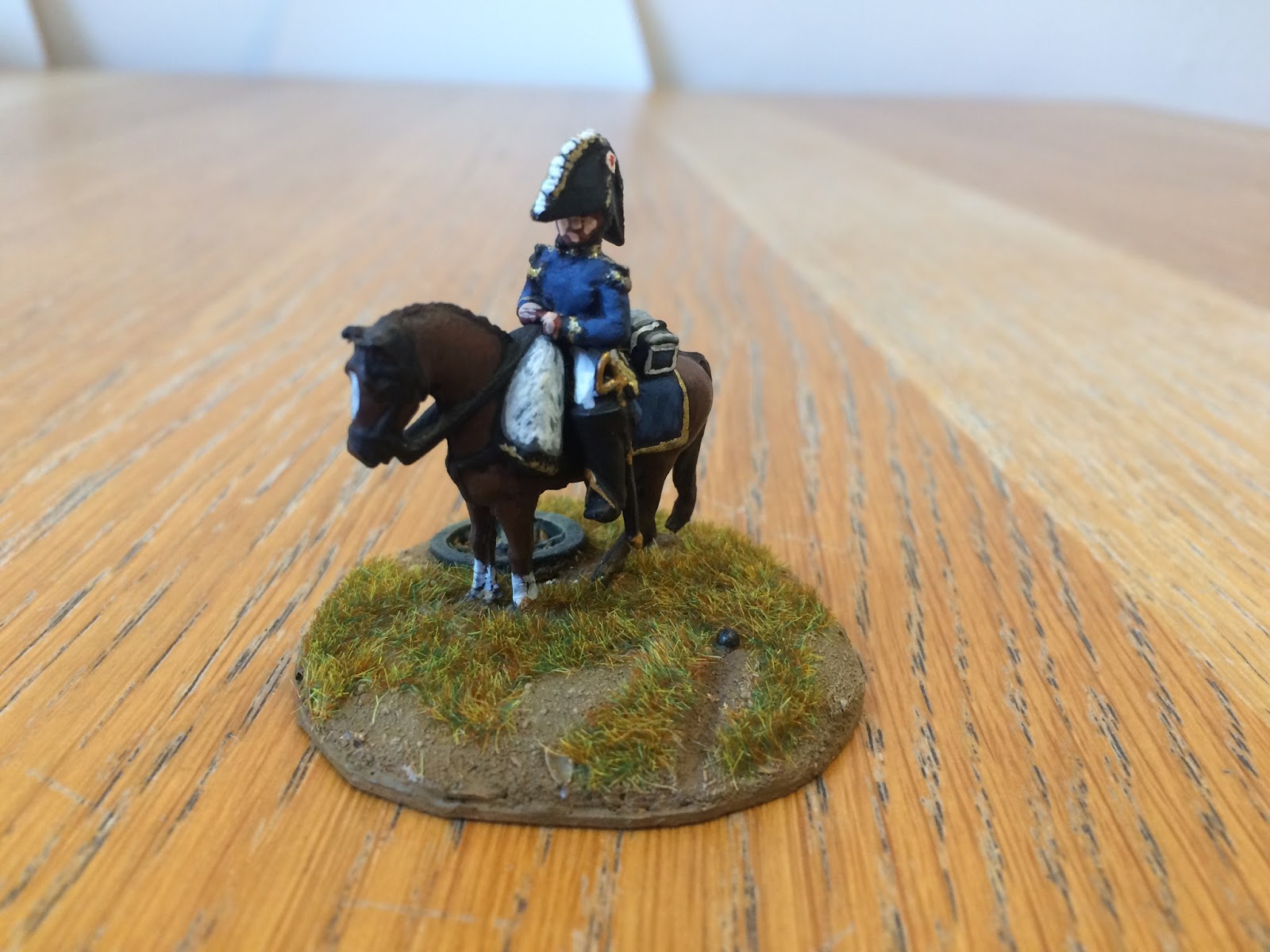
They are three 20mm Minifigs French generals that I must have bought some time in the 1980s and which have been lying around undercoated for decades.  So, as I've been painting 20mm French Napoleonics recently I thought I'd get these finished too.
Acceptable casualties.
Having improved my horse painting (in my opinion) over the past few years with my efforts on dragoons and cuirassiers, etc., the horses were straightforward.  However, for these guys I wanted to have them on round bases (not WRG 1685-1845 standard general bases, note) with something else going on to distract from what are fairly dull figures (apart from the paint job obviously).

For the first one shown I finally managed to work in a casualty figure from my first ever box of Airfix Napoleonic French (c. 1976), just lying there whilst the general rides by nonchalantly.

The next one is probably the dullest figure in terms of pose (ignore the hat), so I painted him as per the illustration on the dust cover of my trusty 1977 reprint of Jack Cassin-Scott's Uniforms of the Napoleonic Wars in Colour 1796-1814, which apparently was Marshall Bessieres' getup.
You want it in green and red?  Why, anything you say colonel.
For this one I decorated the base with some gravel and behind the figure is a tree-stump made from a clove I found in a takeaway curry (I've got a few of those drying in my bits box now).
Note clove pretending to be a tree-stump.
It was a bit bendy even after drying so it has had a good few coats of paint to stiffen it up.  Also, I had thought to add some foliage to it but then considered that maybe there would be just too much green on this one.  It's amazing how much you can write about something you found in a curry.

The last figure is more soberly attired and sitting calmly on his horse beside a wheel from a (1970s) Airfix cannon (the one that came off the cannon on a dragoon base in fact).
Three wheels on my waggon... no wait, here it is.
However, displaying remarkable sangfroid the general is ignoring something else going on on the other side of the base, which is slightly more alarming.
Well pick it up and chuck it back then.
As you can see, a large cannonball has furrowed the ground just next to his horse.   This was made using one of those round headed pins you used to get with new shirts.  I cut most of the pin off leaving about 5mm so I could secure it into the base.  A spot of black paint and some light dry-brushing with steel finished the job.

Sunday, 4 September 2016

A Few More French

As the title of this post suggests here are a few more 20mm(ish) plastic French Napoleonic infantry that I completed last month.
These are the next regiment of Italeri French that I posted about a few months ago.  As I mentioned previously there are enough figures, including command figures, in the two boxes I got to make six regiments of 16 figures each.  These are based for the WRG 1685-1845 rule system.
Reviewing where I am now though I'm not sure I'm going to need many more infantry regiments so I will take a view on what I need and whether I should be using my time more usefully on some of my (many) other projects.

However, next up on the plastic Naploeonic front are some cuirassiers and some very nice Italeri Hussars (in shakos) which I am looking forward to getting finished.  I'm also going to get a better camera as these images are far too blurry and not up to my preferred standard.

Saturday, 4 June 2016

Pretty in Pink

Like a lot of people I've always been a bit nervous about painting horses and therefore cavalry, but needs must and I actually enjoyed painting these 1/72 scale Napoleonic French dragoons by Italeri.  I decided to get these figures because previously the only plastic cavalry I had had were the original Airfix cuirassiers, which are really terrible figures.  Plus, I thought it would be nice to have dragoons instead for a change. 
The figures are excellent and the plastic is quite stiff and takes the paint fairly well.  There are 17 horsemen in the pack so I could therefore just about make six bases of three (on 60mm x 40mm bases as per WRG 1685-1845).  The box art has them depicted as one of the regiments with pink facings and so I thought 'you know, why not?' 
After the figures had been washed and glued together (with standard PVA) they were undercoated in black acrylic.  I painted the horses first, giving them a liberal coating of Tamiya Red Brown (XF-64), Hull Red (XF-9) or Linoleum Deck Brown (XF-79), apart from the trunpeter's horse which was base-coated in light grey. 
Thereafter, using a combination of dark washes and highlights the horses were finished.  Quite easy really.  Once the horses were done the riders were painted using my usual 2-stage technique, that is I block in the main areas with a shade coat and then just add one layer of highlighting - my eyesight and skills aren't good enough to do more than that (plus I've not got the time).
For the final base I was one figure short of the 18 that was needed, so instead I had two figures galloping past a destroyed cannon.  This was an old Airfix one from the 1970s that was still knocking about but had lost a wheel.  This was repainted and added to the base.
I quite like this little diorama because although actually the same figure, the riders look different because they are on different horses.  I also like the way they seem to be looking down at the gun as they ride by.

Saturday, 28 May 2016

French Infantry

Things are a bit chaotic at the moment (at work and at home) and my small workbench is barely visible what with half painted figures, bottles of glue and bits of polystyrene and cardboard all over the place.  All the signs of frenetic multi-tasking.  Anyway, here are some figures that I finished last week or so: Italeri French Napoleonic infantry.
These are very nice figures and far outstrip any other 1/72 scale plastics I've seen (mainly on Plastic Soldier Review, rather than in the flesh).  Being later period figures they are wearing trousers over their breeches which makes a change from the old Airfix figures I have painted previously (see here and here).
I also took the opportunity to make them a bit more campaign style with some of them wearing brown trousers.  The poses in the packs are fairly static but they are nice and robust looking and the detail easily rivals things like the 28mm Perry plastics (in my opinion).  In fact these figures are actually quite tall, being closer to 25mm than the regulation 20mm.
There are voltigeurs and grenadiers in the mix but for my units I just painted them all as fusileers (although I left the red strips on the grenadiers' shakos - I may paint over them later).  I quite like the figure reaching back into his cartridge box, although from some angles he looks like he's massaging his lumbago.

Having bought two packets of these I can make six 16 figure units (based on 60mm x 20mm bases as per WRG 1685-1845) and because there are three officers, drummers and standard bearers per pack that means I don't have to scrabble around in my spares box looking for figures to convert for the command elements.
For information, my painting style for this scale (and 15mm) is to undercoat in black and then paint a shade coat (light grey for white areas) and then overpaint the main colour, letting some of the shade layer show through.  I'm not patient enough to do that whole three layer system thing required for larger figures.

For the faces I paint them a sort of rust colour and then dab four points of flesh on the chin, nose and cheeks, which does the trick.  Finally, I base them using coarse shelly sand stuck on with PVA glue, giving it a wash of dark earth, followed by a dry brush with a sand colour and then with some Javis flock added leaving plenty of earth showing through.

Friday, 13 May 2016

French Artillery

It's nice to be back painting again and here is what I finished last week, some French Napoleonic artillery.
Esci cannons with Airfix crew
These are 20mm plastics and the guns come from the Esci foot artillery set, which actually has guard artillery crew.  Being a bit more down to earth I prefer to have fewer rather than more guard units and therefore I paired the guns up with some Airfix (line) artillery crew.
12pdrs
The Esci set is quite generous and comes with two normal cannon (12pdrs I think) plus two howitzers.
The howitzer
I had managed to misplace one of the howitzer barrels over the years (it turned up just after I'd completed all these, of course) and so I used a cannon from the Airfix set.  The Airfix gun carriages are far too small and have the wrong number of spokes on the wheels, amongst other problems, but the gun itself when put onto the Esci carriage doesn't look too bad.
Airfix cannon on an Esci carriage
As the cannon I used was from the Airfix set I nostagically crewed this piece with the few figures I had remaining from the the very first Airfix artillery figures I got, from sometime back in the 1970s.  Not many of them left but they still paint up OK (I had refurbished the remaining marching figures as an infantry unit previously).

The guns and crew are on 40mm x 60mm bases and my usual basing technique of coarse shelly sand painted in Revell Dark Earth, with a bit of dry brushing and then selective flocking, completed them nicely.

Saturday, 19 March 2016

More Airfix French Redux

Well, it's been a while since I posted on my blog having been away quite a lot in the intervening period, to Turkmenistan, Gabon, Uzbekistan and Austria if you must know (the last one was a holiday).  However, in the meantime I have not been entirely idle.
So, I've done a bit of painting.  These are 1/72 scale Airfix figures and are in fact the 'infantrymen' you get in the Airfix French Artillery pack.
They've got longer swords than infantry are supposed to have and the usual Arifix 'character' but they don't look too bad once painted up.  The drummer is a standard Airfix French infantry figure.
I should add that the officer is actually the French artillery sergeant that comes with the set, but with a bicorne made out of plasticine.  After I'd taken the photos I noticed a wee blob of blue paint on the end of the bicorne but that's gone now.

Saturday, 29 August 2015

One-Hour Wargames 12: An Unfortunate Oversight

The point of this scenario, taken from Neil Thomas' book One-Hour Wargames, is that the defending commander has been tasked with holding the bridge (here's one (or rather two) I made earlier) but is unaware that there is also a ford in the vicinity which may allow him to be outflanked.
Nice bit of planking.
The scenario states that possession of the hill by the end would determine the victor.  This map shows our set-up, with the bridge on the left and the ford on the right.
OHW 12: An Unfortunate Oversight
This game pitched Napoleonic French against a ragbag of Coalition forces, comprising mainly Prussians with some British thrown in for no adequately explained reason. This was the initial setup, with two regiments of French foot trying to cross the bridge, with another two foot regiments plus dragoons and cuirassiers attempting to sneak round and flank the Allies via the ford.
French poised to cross the river at two points
You will notice that the battlefield is actually the reverse side of an old Subutteo pitch with the lines showing though, clearly indicating that this would be a game of two halves.
French infantry plus Mameluke general cross the bridge
As was required by the scenario, the game started with both wings of the French army trying to get across the river as fast as possible.  My scheme was to keep the Allies occupied on the left whilst my cavalry rushed across the ford on the right and grabbed the hill.  At least that was the plan.
French cavalry cross the ford (very old Hinchliffe figures)
However, with surprising alacrity the Allies pushed most of their forces towards the hill leaving a containment force on the French left.  The fight was on.
Prussians block French advance on the left
On the right the French cavalry raced towards the hill but the Prussians got there first.  Meanwhile the French infantry on the right followed up slowly.
View from French right - cavalry nearly at the hill.
Forcing some of the Prussian infantry into square, the cuirassiers were repulsed by close range fire as they crested the hill.  The looming presence of some Prussian dragoons didn't help.
Cuirassiers thankful they have backplates as well
Meanwhile on the French left a prolonged firefight developed with the French proving to have the advantage (eventually).
Prussian infantry running away (for a bit anyway)
However, this was of no help on the right, where the retreating cuirassiers were charged in the rear by the Prussian dragoons and routed.
Prussian dragoons crash into repulsed Cuirassiers
Unhelpfully, the other squadron of Prussian dragoons charged the French dragoons and they too wavered and fled.  The French infantry having just made it across the ford had no option but to form square and await their fate.
Dragoons rout, infantry in square, what else could go wrong?
Meanwhile on the left the Prussians were finding their resolve again, and although chased by a regiment of light infantry, the Prussians reformed, supported by troops from the centre.
For the French left, the tide is about to turn.
With the French right wing either routing or pinned in square the French left was not strong enough to take the hill, or indeed move out of the village, and started to waver and then crumble.  And there it ended after eight moves.
Endgame
Overall, this was quite disappointing performance by the French.  The 'unfortunate oversight' proved to be nothing of the sort as the Allies could quickly move to block the French advance on the right, whilst containing the smaller force on the left.  Perhaps next time I shouldn't split the French forces but then there would be even less to detain the enemy from rushing over to the ford to stop the advance.
It's hip to be square.
It may have worked if the crossing points were further apart or the Allies moved slower, or were inhibited in some way (such as by dice-enforced incompetence) but that was not how it turned out.

In case you were wondering, the figures consisted of Airfix and Esci 20mm plastics (it's not often you see Airfix plastic Highland light infantry on the table), and for historical reasons (and because the plastics aren't finished yet) the French cavalry and generals were represented by some (very) old "25mm" Hinchliffe figures, painted sometime last century.

The rules were WRG 1685-1845, which are still simple and elegant.  I don't know why people complain about the move sequence because we've never had trouble with it.  The only thing I noticed however, was the command and control aspect of it, as I'd forgotten how older rule-sets such as these often allow units to shoot off all over the place, without the requirement to maintain battle lines and higher level cohesion.  Nevertheless, they are still a serviceable set of rules which we will continue to use until we find something better.
Handmade buildings
Finally, the terrain was all scratch built, including the buildings.  You can't tell but the cottage on the right started off as a box that a Hornby goods wagon came in (it's not in there now) and the stones on the chimney were all lovingly hand carved by Geoff from a piece of plywood.