Showing posts with label Italeri. Show all posts

Friday, 23 August 2019

ACW Adventures in Basing No. 9

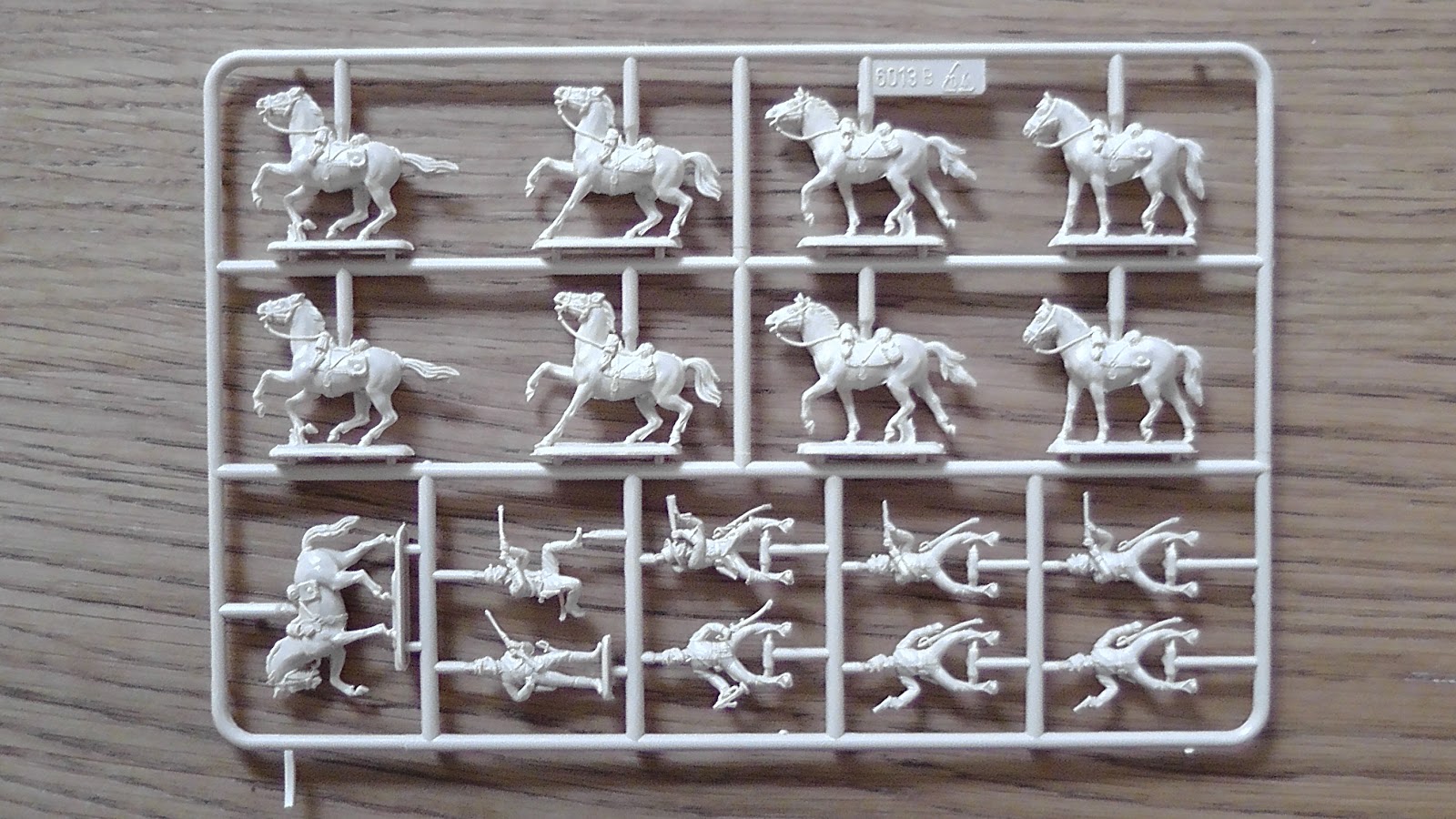
A very long time ago (2012 to be exact), I did a post featuring a box and some unpainted sprues of 1:72 Italeri ACW Union Cavalry, promising to get on with them ASAP.  The good news is that I have now finally finished and based them.
These are very nice figures and being a slightly stiffer type of plastic hold the paint very well.  It doesn't come out clearly in the photos but I painted these using a two stage tone system, i.e. after a thorough black undercoating I did the base coat colours (mainly from an old but trusty pot of Revell 5077 blue - which I use for painting Napoleonic French as well) and then some highlights with a slightly lighter blue.  It's the same system as I use for 15mm figures.
Faces were done using a 'rust' coloured base (Revell 37 Reddish Brown) and then flesh colour daubed in four places: on the cheeks, nose and chin.
Horses were initially painted in various shades of brown (e.g. Revell 85 Braun, and some in darker browns).  Thin black wash was then applied to each horse's face, manes, tail, legs and underparts in layers generally to build up the contrast and create variation across the animal.  Tackle was painted black afterwards.
Finally, I needed to upgrade my generals, which are very old plastic Spencer Smith figures (technically 40mm I think).  I stripped these down from their flat mid 1980s' paint job and removed the mould lines properly this time.  After painting, all figures were varnished using Windsor & Newton "Galeria" acrylic matt varnish, as recommended by a couple of people on the TMP forums.
Basing was my usually coarse shelly sand on MDF bases, with added static grass.  For some reason I never painted the sand on earlier ACW figures I'd based, so I kept with tradition on these ones.

So, remarkably, that's pretty much all of my ACW figures painted.  The only thing I might need is some dismounted replacements for the cavalry, but they feature so rarely in our games (when we have ACW games) that they're not even on my list of things to do.

Sunday, 14 July 2019

One-Hour Wargames 16: Advance Guard

This is the after action report (AAR) for the first game in the One-Hour Wargames Campaign that we started recently.  The idea was to begin with a neutral 'encounter' sort of scenario and see how it went from there.  For this game my freshly painted 20mm Napoleonic French (Italeri mainly) would be up against Geoff's Prussians.
The scenario allowed both sides to have six units and the objective was to be in uncontested possession of the central village after 15 moves.  For this game we used the One-Hour Wargames horse and musket rules, slightly amended. The book suggests that orders of battle be decided randomly.  Consequently starting forces looked like this:

French
3 x line infantry
1 x light infantry
2 x cavalry (dragoons)

Prussians
3 x line infantry
1 x cavalry (dragoons)
2 x artillery

As you can see from this, the French started with more infantry (including light infantry) and more cavalry than the Prussians, who were lumbered with two artillery batteries.  As we shall see, the lack of mobility, in what was suppposed to be an encounter battle, with both armies marching on to the table, doomed the Prussians from the start.
Scenario 16: Advance Guard
My plan was very simple: to advance my line infantry rapidly to the objective, using the cavalry to sweep round the open left flank (see map).  One of my infantry units would meanwhile hold the gap between the village and the wood to cover my light infantry into the wood on the right flank.  The plan worked perfectly.
French troops rushing the village
Cavalry to the left of me, infantry to the right
In fact the Prussians had barely got going before the French were already in the village and were beginning to threaten both flanks.
Prussians caught flat-footed
On the left, one unit of French dragoons immediately engaged the Prussian cavalry in hand to hand combat, whilst the other sneaked round the back of the melee to threaten the advancing infantry, forcing it into square.  In the centre the Prussian infantry stopped to fire at my troops in the village whilst another French infantry unit moved up on the left of the village.
Meanwhile, on the right my light infantry had advanced (very) rapidly and had managed to get into the woods without being intercepted.  Again the Prussian infantry had lined up opposite the French and started to engage in a fire fight.
From this point on things deteriorated very rapidly for the Prussians.  On the left after a few rounds of back and forth, the Prussians dragoons were defeated and the French dragoons then moved against the flank of the infantry facing the village.  Meanwhile the other dragoon unit had crossed the front and/or side of the square and charged the Prussian guns before they could bear, whilst the French light infantry in the woods had extended into line to engage the other Prussian battery from cover.
Not looking good for the Prussians frankly
The last blow of the game came when the French dragoons crashed into the flank of the Prussian infantry.  And there was nothing he could do about it.
Contact!
Neil Thomas' rules for horse and musked are quite brutal (to say the least) and the Prussians were swept away in one go.  And with the very real prospect of the adjacent Prussian line about to suffer the same fate, with the Prussians having basically no chance of getting into the village let alone taking control of it, that was the end of the game.
Endgame
Overall, the game was a frustrating one for the Prussians.  They were only able to deploy slowly because they had two artillery units and were deficient in cavalry.  The fact that the French got to move first, combined with the rapid movement rates, long shooting ranges and brutal outcomes from any sort of reverse, which define the OHW rules, meant that right from the start the Prussians were always going to have an uphill struggle to win.

On the other hand, it was an emphatic victory for the French and even more enjoyable because for most of my troops this was their first battle.  Perhaps it is true that the better the paint job the more likely one is to win, if I may say so myself (this thesis may require more research).

Anyway, with a win for the French the honour falls to me to choose the next battle and I have decided this will be #14: Static Defence, which will feature in the next campaign AAR.

Saturday, 29 December 2018

Hurrah and Hussar!

Just to prove I'm still capable of painting figures as well as making buildings, here are a few squadrons of French Napoleonic hussars I completed this month.
1st Hussars
These are Italeri French Hussars (#6008), which are very nice figures and easily match the dragoons I painted recently.  The figures come in a variety of uniform combinations, with some sporting campaign overalls, with or without pelisse worn or slung.
2nd Hussars
I decided to make six bases and paint each pair as a different regiment.  So, to get a variety of uniforms I settled on painting the 1st, 2nd and 6th regiments.  The box comes with 17 figures, so to make up the last squadron I had to add a figure from somewhere else to get to a round 18 figures and therefore six bases of three.
6th Hussars
The extra figure is wearing a busby, thus masquerading as an elite company trooper, and is actually the officer from the Italeri Guard Horse Artillery set (#6018), the rest of which may feature in a future post.

With these hussars, I'm nearly done with 20mm French Napoleonic cavalry, although I did get a box of Italeri French Light Cavalry #6080 (i.e. Chasseurs a Cheval) a few months ago, which as a cavalry type were more numerous and more commonly deployed than hussars.  So I may get around to painting them next year, once I've got a few other projects out of the way first.

Wednesday, 5 October 2016

Jägermeister

I've still got the painting bug and am currently working on my 20mm French Napoleonic collection (see earlier posts this year).  Having completed various infantry units and some excellent Italeri dragoons, I thought I should really paint those Esci cuirassiers that have been under the bed since about 1990.  In fact I'd been in two minds about painting them at all because the figures aren't as good as the dragoons by a long chalk and I was thinking maybe I should just get some Italeri carabiniers instead.
Deliberating on all this I was of course distracted along the way and impulse-bought and painted some HäT Industrie Württemberg cavalry (Jägers) in the two weeks it took me to decide what to do.  These were the first HäT figures I'd painted and I found them quite nice with a lot of well defined detail.  The plastic, although a bit flexible, takes the paint very well.
There are only four poses (12 figures altogether) on three identical sprues in the box (and only two types of horse), but one man on each sprue comes with a choice of arms that you have to glue on.  I made one of them a trumpeter in the vivid yellow coat.  I think the troopers look quite good in their black gauntlets, dark green tunics and yellow trim.
Based up for the WRG 1685-1845 rules on 60mm x 40mm bases, with my usual concoction of coarse sand, painted dark earth then dry brushed in a sandy colour and then flocked, I consider that they've turned out very well.  And I think I'm really getting the hang of painting horses now after my initial hesitations. 
Oh, and finally, here are the cuirassiers. I had two ancient packets of them stashed away and was able to make quite a few bases although whether they'll all get an outing at the same time remains to be seen.

So that's it then, apart from six bases of Italeri French hussars to finish and perhaps one or two more Italeri line infantry regiments (possibly to be painted as Saxons or Swiss, just for a change).

However, I'd really like to get some HäT Württemberg infantry now, as well as the HäT French Guard Chasseurs a Pied, but neither seem to be available in the UK at present.  Still, I could always acquire and paint up some carabiniers in the meantime...

Sunday, 4 September 2016

A Few More French

As the title of this post suggests here are a few more 20mm(ish) plastic French Napoleonic infantry that I completed last month.
These are the next regiment of Italeri French that I posted about a few months ago.  As I mentioned previously there are enough figures, including command figures, in the two boxes I got to make six regiments of 16 figures each.  These are based for the WRG 1685-1845 rule system.
Reviewing where I am now though I'm not sure I'm going to need many more infantry regiments so I will take a view on what I need and whether I should be using my time more usefully on some of my (many) other projects.

However, next up on the plastic Naploeonic front are some cuirassiers and some very nice Italeri Hussars (in shakos) which I am looking forward to getting finished.  I'm also going to get a better camera as these images are far too blurry and not up to my preferred standard.

Saturday, 4 June 2016

Pretty in Pink

Like a lot of people I've always been a bit nervous about painting horses and therefore cavalry, but needs must and I actually enjoyed painting these 1/72 scale Napoleonic French dragoons by Italeri.  I decided to get these figures because previously the only plastic cavalry I had had were the original Airfix cuirassiers, which are really terrible figures.  Plus, I thought it would be nice to have dragoons instead for a change. 
The figures are excellent and the plastic is quite stiff and takes the paint fairly well.  There are 17 horsemen in the pack so I could therefore just about make six bases of three (on 60mm x 40mm bases as per WRG 1685-1845).  The box art has them depicted as one of the regiments with pink facings and so I thought 'you know, why not?' 
After the figures had been washed and glued together (with standard PVA) they were undercoated in black acrylic.  I painted the horses first, giving them a liberal coating of Tamiya Red Brown (XF-64), Hull Red (XF-9) or Linoleum Deck Brown (XF-79), apart from the trunpeter's horse which was base-coated in light grey. 
Thereafter, using a combination of dark washes and highlights the horses were finished.  Quite easy really.  Once the horses were done the riders were painted using my usual 2-stage technique, that is I block in the main areas with a shade coat and then just add one layer of highlighting - my eyesight and skills aren't good enough to do more than that (plus I've not got the time).
For the final base I was one figure short of the 18 that was needed, so instead I had two figures galloping past a destroyed cannon.  This was an old Airfix one from the 1970s that was still knocking about but had lost a wheel.  This was repainted and added to the base.
I quite like this little diorama because although actually the same figure, the riders look different because they are on different horses.  I also like the way they seem to be looking down at the gun as they ride by.

Saturday, 28 May 2016

French Infantry

Things are a bit chaotic at the moment (at work and at home) and my small workbench is barely visible what with half painted figures, bottles of glue and bits of polystyrene and cardboard all over the place.  All the signs of frenetic multi-tasking.  Anyway, here are some figures that I finished last week or so: Italeri French Napoleonic infantry.
These are very nice figures and far outstrip any other 1/72 scale plastics I've seen (mainly on Plastic Soldier Review, rather than in the flesh).  Being later period figures they are wearing trousers over their breeches which makes a change from the old Airfix figures I have painted previously (see here and here).
I also took the opportunity to make them a bit more campaign style with some of them wearing brown trousers.  The poses in the packs are fairly static but they are nice and robust looking and the detail easily rivals things like the 28mm Perry plastics (in my opinion).  In fact these figures are actually quite tall, being closer to 25mm than the regulation 20mm.
There are voltigeurs and grenadiers in the mix but for my units I just painted them all as fusileers (although I left the red strips on the grenadiers' shakos - I may paint over them later).  I quite like the figure reaching back into his cartridge box, although from some angles he looks like he's massaging his lumbago.

Having bought two packets of these I can make six 16 figure units (based on 60mm x 20mm bases as per WRG 1685-1845) and because there are three officers, drummers and standard bearers per pack that means I don't have to scrabble around in my spares box looking for figures to convert for the command elements.
For information, my painting style for this scale (and 15mm) is to undercoat in black and then paint a shade coat (light grey for white areas) and then overpaint the main colour, letting some of the shade layer show through.  I'm not patient enough to do that whole three layer system thing required for larger figures.

For the faces I paint them a sort of rust colour and then dab four points of flesh on the chin, nose and cheeks, which does the trick.  Finally, I base them using coarse shelly sand stuck on with PVA glue, giving it a wash of dark earth, followed by a dry brush with a sand colour and then with some Javis flock added leaving plenty of earth showing through.

Saturday, 7 May 2016

There is Nothing Like a Dane

I've only been to Denmark once, and that was a school trip when I was 17 where I ended up in hospital with food poisoning, meeting a number of charming Danish nurses in the process... Anyway, back to the real world (sadly).
On the contrary, these are exactly like Danes
We managed seven wargames last year, which was pretty good for us and I'm hoping we can fight more than that this year.   If you were counting I feel I should confess one of them from last year wasn't blogged because I lost the camera on the way home so nothing survives of it apart from the sketch-map (I'm thinking to rerun the scenario again this year).  Anyway, here is the game we played last weekend.
Battle of Oeversee
The scenario was taken from Neil Thomas' book Wargaming Nineteenth Century Europe 1815-1878 and was a recreation of a rearguard action between retreating Danes and advancing Austrians, the Battle of Oeversee (Second Schleswig War, 1864).
The real battle was an incident in relation to the intractable 'Schleswig-Holstein Question', the solution to which Palmerston remarked was only understood by three people: Prince Albert (who was dead); a German professor (who went mad thinking about it); and Palmerston himself, who claimed he'd forgotten it. In fact the book gives an excellent overview of the situation and the political background to the 'question', as well as the lead up to this particular encounter.
Initial Danish positions with Colonel Müller leading
In essence, the Danes, after being defeated by the Austrians at Jagel-Overselk, were trying to retreat northwards to a line of fortifications, the Danevirke.  A rearguard of around 3,000 men under Colonel Max Müller was tasked with holding up the Austrian army (comprising an advance guard of around 4,000 troops), which, after being bested during the Italian Wars of Independence five years previously, a) now relied heavily on the bayonet attack and b) had much better artillery that was used more aggressively.
View from behind Danish starting positions
The Austrian's objective therefore was to force the Danes off the road and to disrupt the orderly withdrawal of the main Danish army.  The scenario gave the Austrians two bronze rifled guns and the 9th Hussars to start with, to be reinforced progressively by Jägers, skirmishers and three units of average infantry.
Austrian 9th Hussars ford the River Trenen
The Danes on the other hand were to have four units of 'levy' infantry (due to low morale) plus an understrength gun.  However, reinforcements comprising another unit of infantry and some artillery was allowed for (in the real battle it never arrived).
Austrian infantry - looking suspiciously like Airfix French Foreign Legion...
The Austrian's scenario objective therefore was to ensure that there were no Danish units within 12cm of the road by the end of turn 10.  The rules used were those set out in Neil Thomas' book, which are fast-play and simple.
Austrians start to pour across the river as the Danes form up
The initial moves allowed the Danes to form up in line across the road and to move through the woods in order to extend the line.  The Austrians advanced across the river rapidly, with the intention of decisively steamrollering the jittery Danes at bayonet point.
Disgraceful evidence of fly-tipping encountered in the woods
Unfortunately for the Austrians there were a number of problems.  The Austrian artillery placed on a hill next to the river was just out of range of the Danes, who, wisely, decided to stay put and not advance into said range.  Secondly, the Austrians, conscious of the game's time limit, were advancing piecemeal over the river to attack straight off the march.  Thirdly, the Danes' reinforcements turned up nice and early (move 3).
Austrians start to deploy, but Danish reinforcements have arrived already
However, despite not being able to soften up the enemy with artillery, the Austrians continued their inexorable advance, hoping to make contact as soon as possible.
Austrians getting closer
As the Austrians advanced their Jägers were able to start peppering the Danes on their left, whom they outranged.  Meanwhile, the infantry and hussars moved into charging range.
Hussars make contact; though half of them didn't get that far
Initiating a charge into the Danes on the right, the hussars lost a significant proportion in the approach but still managed to make contact.  The Danes recoiled, but due to a quirk (or misunderstanding) of the rules the cavalry was not able to follow up immediately.
Danes retire briefly, but cavalry stopped (for some reason)
At that point, the Danes that had been pushed back were able to fire again at the milling hussars and basically wipe them out, mainly due to poor die throwing from the Austrians.
Hussars wiped out: offending die score foregrounded
Meanwhile, some Austrian infantry had made contact with the Danish centre, but again, with a series of brutal die throws the centre held and the Austrian attack faltered.
Austrians faltering
Another round of melee saw the Austrians actually manage to push the Danish centre back, but the attacking infantry was too damaged to follow up.  Again, the Danes who had been pushed back were able to fire into the Austrian infantry who had just beaten them and they were decimated.
Depleted Austrians in centre, about to be blown away
So, with two units lost and the clock ticking down (we were on move 11) it was clear that the attackers were not strong enough to break the Danish line and therefore the Austrians conceded the game.

So, a bit of a frustrating game for the Austrians, and an easier than expected one for the Danes (me).  Overall though, I think our main problem was with the rules.  Neil Thomas sets out clearly his rationale for the rules he produces in his books.  However, for us I think that the rules are generally too simple and sacrifice more realistic mechanics in order to create a fast-play framework.

That said, a frontal attack by hussars against steady infantry is unlikely to succeed in any rule-set, although the fact that the Austrian artillery was out of range at the start was mainly because our table was longer than the set up envisaged in Neil Thomas' scenario.

However, the period is an interesting one (particularly when you compare it to what was going on in America at the same time) and there are a lot of good ideas in the book.  Geoff had spent a good few months preparing and painting his armies (a combination of converted Airfix, Italeri and Zvezda pastics, with some Irregular 20mm figures thrown in) and no doubt we will be fighting some more games from this period this year, though perhaps with different rules.

Wednesday, 23 May 2012

ACW Adventures in Basing No.5

Actually, this post isn't about basing per se, but does address the issue that the Union forces (i.e. mine) never really had cavalry.  But they do now.
And it's these - 1:72 Italieri Union Cavalry, bought a few years ago (see price tag) but heading to the top of the pile.
They are actually excellent figures and I'm looking forward to getting on with painting them, much though I tend to put that part of the process off for as long as possible.
The good news is that I am slowly inching towards arranging a play test of the Regimental Fire & Fury Rules I bought last year, not to mention a go at Black Powder, which seems to be a strangely persistent set of rules (a good thing!) and which was to be my new project from last summer but work and other things sadly got in the way.