Showing posts with label DBM. Show all posts

Tuesday, 14 October 2025

Walls in Ruins

Further to my earlier post about some 15mm ancient city walls and buildings I'd made, I thought some evidence of violent siege would be in order.  So I made these.

Mind the gap
The idea was to have damaged sections that would match lengths of unbroken wall, so that these could be substituted in as necessary.

Rear view
The centre bit of wooden wall could also be removed to leave a gaping hole, if that was needed.

Something appears to be missing
The walls were made from cardboard and polystyrene fixed together with PVA glue.  Fine sand was then glued to the walls and painted.  The piles of masonry were made from polystyrene offcuts and were intended to hold the wooden wall in place.

Time to get the decorators in
Liberated wooden coffee stirrers were used to make the planking, undercoated in black then painted with a dark earth colour.  A couple of black washes were applied and then the wood was drybrushed with a beige or buff colour.

What, no crenellations?
Overall, I think they've worked quite well.  Just need a siege to try them out...

To be honest, the damage is barely noticable


Saturday, 12 October 2024

The Walled City

Before our pocket money increased to the level where we could buy such wonderous things as those plastic Airfix forts that aren't available anymore, we used to make our own battlements on which we would line up our soldiers. In those days, my dad had a preference for Van Heusen shirts and at that time these came in cardboard boxes, usually with an illustration on the front.

I have a very clear memory of cutting out the drawing of a castle from one of those boxes and then using the rest of it to make the other walls, flimsy battlements and the wobbly walkways between them, all held together with sticky-tape.  It used to take ages to put the soldiers up there (Airfix Ancient Britons, French Foreign Legion and Guards Colour Party mainly) and only one well-placed hit by a nail fired from a Britains 25 pdr gun to knock them all off again.  Those were the days.

Scratch-built 15mm scale ancient town walls
Some battlements, yesterday

However, since then there have been some slight improvements.  For one of our early DBM campaigns (my 15mm Lydians vs Geoff's Persians) I made some simple city walls for my troops to man.  Actually that battle was an exercise in my troops trying to get off the table as quickly as possible as I was outnumbered three to one, not to mention being attacked from two directions at once (those pesky Persians).

Scratch-built 15mm scale ancient town with walls
I remember when this was all fields (of fire)
Subsequently the extent of walls expanded and so did the various buildings I've made to put inside them.  The construction of all walls and buildings uses thin polystyrene sheets and cardboard, coated in fine sand then painted with a mixture of household emulsion and various acrylics.  The buildings are generic enough to also be used for locations such as Mexico (e.g. Mexican Revolution) or arid Africa (e.g. AK47).  They are simple to put together and I keep adding to the pile when I feel like making something (regularly).

Scratch-built 15mm scale ancient town walls with Hebrews
Early Hebrews man the walls
Just to add that the figures in these photos are 15mm Chariot miniatures sold by Magister Militum, comprising a DBA 3e Early Hebrew army (that's I/34c for those of you paying attention at the back).

Sunday, 7 June 2020

One-Hour Wargames 13: Escape

We have been playing a mini-campaign based on a branching sequence of scenarios taken from Neil Thomas' book One-Hour Wargames.  The approach to the campaign is set out here.  So far we had played two games, Scenario 16 Advance Guard and Scenario 14 Static Defence, and as I won the last game in the sequence (and to be honest the one before that) I got to select the next encounter.
All quiet on the Eastern (Anatolian) Front
This is therefore the AAR from the game we played (in February), 13 Escape, which to be frank turned out to be a bit of a dud, so I couldn't be bothered wrting it up at first, but then for completeness (and due to some time on my hands brought on by the Covid-19 lockdown) I thought I should.
A simple plan
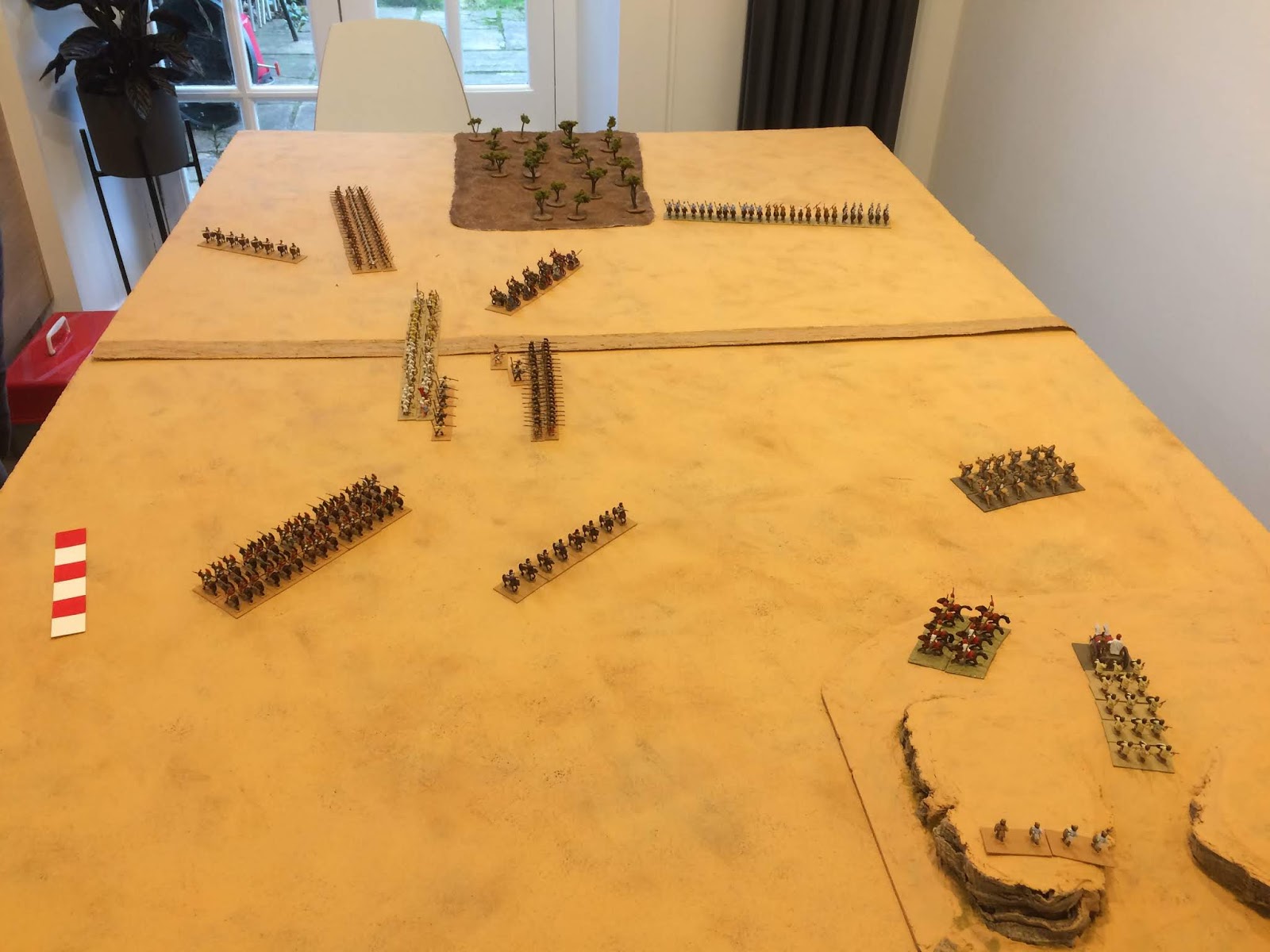
The book describes the situation thus: "The blue army is returning home from raiding Red territory.  Its journey is blocked by a number of Red units."  The scenario gives both sides six units, with the Reds having one unit on the table, two units coming on from the hill (marker 1, see map) at turn 2, two units arriving on the table from behind the wood (marker 2) at turn 4 and a single unit coming on at marker 3 on turn 6.  Blue's objective was to get at least half of its units off the far end of the table via the road.
Lydian start line
For this game we decided to get our old De Bellis Multitudinis (DMB) armies out as we'd not used them for quite some time.  The scarpering Blues were therefore my Lydian (I/50) army and the blocking Reds were Geoff's Early Achaemenid Persians (I/60).  The single Persian unit allowed on the table was a line of Sparabara blocking the road.
Sparabara in the way, again
The game got off to a rapid start, particularly as we both suddenly realised/remembered that the rules allowed our units multiple march moves when not in close proximity to the enemy.  This meant that, with some excellent PIP dice throws, within two moves the Lydians were nearly halfway across the table even before the Persian pursuit force could get their boots on.
Lydians advance (very) rapidly
The Persian's plan seemed to be to use their numerous cavalry as the pursuit forces and the first of these appeared over the hill at move 2.
However, the Lydians continued to push forward, not only in the centre, to engage the Sparabara, but also on the flanks, in order to encircle the Sparabara if necessary but also to allow a rapid exit off the table if possible.  Meanwhile, some Lydian (Paphlagonian) light horse turned to face off the Persians streaming down from the hill.
Nice bit of flanking
The problem for the Persians was that they were never really able to catch up.  Whilst the Lydian hoplites and psiloi were squaring up against the Persian Sparabara in the centre, the Lydian cavalry, chariots and auxilia were literally flowing round the flanks behind them.  However, the Persian cavalry was still too far away to be effective.
A confusing picture
As can be seen from the above picture, the Sparabara (white and yellow tunics, pale green base) in the centre, have been contacted by Lydian psiloi, whilst other Lydian units flow around the sides.  The Persian cavalry meanwhile is mostly still on the hill or behind the wood on the right of the table.
Lydian hoplites push back Persian Sparabara
In the centre the Lydian hoplites finally reached the Sparabara and started to push them back.  The Persian cavalry was still in pursuit but was having trouble reaching any of the Lydians, apart from the Paphlagonian light horse sent back to delay them.
Paphlagonian light horse verses Persians
Meanwhile, most of the other Lydian units were getting close to the table edge preparing to exit.  As DBM is a bit flexible when it comes to defining units, we had decided that the Lydians needed to get half of their original number of elements off the table to win.  And then, finally, some Persian Immortals turned up.
Persian Immortals - better late than never I suppose
As can been seen, the Immortals were somewhat outnumbered by the hordes of Lydian auxilia.  But in the end, it didn't really matter, because the Lydian cavalry was already streaming off the table and most of the auxilia would soon follow suit.
I'd be worried if I were you
Fundamentally, the Persians never really managed to catch up with the Lydians, slowing them down or delaying them enough so that they could be destroyed.  I think this was a reflection of the DBM rules which allowed march moves so that the Lydians were always too far ahead.

That said, one of the things about the OHW scenarios is that the table set-ups are very simple with not many features on the table.  This means that there is very little tactical use of terrain and the issues (and interest) that that can cause can be missing.

However, one thing I did notice from re-reading the OHW scenario was that it is based on another scenario from the really excellent CS Grant book Scenarios for Wargames (WRG, 1981), in this case Scenario 10, Breakout.  In fact, a number of the OHW scenarios are simplified versions of the ones created by CS Grant.
Every wargamer should have one of these
Looking at it after our game it was clear that the Breakout scenario is a more complex and potentially more interesting set-up than the one in Neil Thomas's book (plus there's a bit more terrain to deal with), and to be homest I wish I'd realised that earlier.

Therefore we decided that for the next game in the OHW campaign series, if there was an equivalent source scenario, then we should try using that, rather than the simple scenario in Neil Thomas' book.  Which is exactly what we did for the next campaign game that I will write about (when I get around to it), Scenario 7: Flank Attack (2).

[In case anyone is interested in the figures, my Lydian army comprises almost exclusively 15mm Chariot (now Magister Militum) figures, whereas the Persians are Essex, all painted and based a very long time ago...]

Saturday, 2 September 2017

Takistan Compound

Since coming back from holiday I’ve been avoiding committing to the plastic/lead painting mountain for some reason.  This is, I know, associated with some deadline pressures at work (which I’ve missed anyway, which makes it worse in a way as the extensions just mean they haven’t actually gone away).  
But when that happens making and painting individual terrain pieces is what I usually turn to, and as noted in an earlier post I have been making various 15mm desert type buildings intended for AK47, ancients (DMB) or even Mexico.
Anyway, here is one of the pieces I’ve made, a compound that wouldn’t be out of place anywhere in Central Asia or Africa.  This is actually based on the examples you can find on the 'Takistan' terrain, originally part of the ARMA2 'mil-sim' PC game, now ported to ARMA3 (using the CUP mod, in case you're interested).
Clearly the terrain is supposed to represent Afghanistan, although maybe it is meant to be Tajikistan (or, heaven forbid, the unpronounceable Kyrgyzstan).
Modelling was my usual technique of cutting strips of thin pizza-base polystyrene which were then glued together onto a cardboard base.  Everything was painted a chocolatey earth colour and then fine sand was stuck to the walls (with PVA wood glue) and a coarser sand glued to the ground.   Walls were then painted in shades of sandy earthy colours with various washes to dirty them up.
Some static grass was added in various places and a tree put into one of the corners.  This is a piece of heather stem (we have a lot of it lying around in Scotland) with some of my home-made clump foliage stuck to the top.
I’ve a plan to make a whole forest of acacia trees using the bag of heather I collected a few years ago, but haven’t got around to it yet.  Overall, the compound turned out quite well and makes a contrast from the mainly white-walled 15mm buildings I also made, which I will post about later.
 
I may make a few more of these ‘Takistan’ type buildings but we shall see how much time, inclination and not to mention storage space, I have to do that.
Russian on the roof

Tuesday, 20 June 2017

Tembe in 15mm

As promised in my previous post, here is the tembe I made.  For those of you who don't know, and I didn't until last week, a tembe is a square African building used by nineteenth century Zanzibar slavers and such like.
Apparently the name indicates its intrinsic squareness as opposed to the normal round huts that everyone lived in during that period (and still do, in some places, as I have seen for myself in Uganda).
Such buildings were used to keep the slaves in (and to stop other slavers stealing them) before shipping them off to wherever they were sold to.
The inspiration for building this (in 15mm scale) was the recent article in Wargames Illustrated magazine (No. 356), where a 28mm building was showcased.  The version featured was made of mdf and had a thatched roof.
However, it struck me that a tembe could have a variety of uses in various periods and locations including ancient near east (as a villa), nineteenth century Mexico (a hacienda) and of course modern Africa, to complement my Peter Pig AK47 armies (as a police station, customs post, or similar).

From the African angle my reasoning was that the building may have been an old tembe that had had a new roof added, which is why I changed the roof to what could be interpreted as tiles (or corrugated iron) instead of thatch. 
Construction was my usual pizza-base polystyrene 'foamboard' stuck to a cardboard base.  The roof was made from corrugated cardboard; actually the cardboard insulating sleeves that you can pick up with take-away coffee.
Around the doors I stuck on matches to represent a timber finish and bars were put on the windows.  These were actually cut from some thick wire - the low 'E' string I'd removed from my electric guitar (a beautiful 'Artists' Series' Ibanez AR420-VLS) when I changed the strings recently.

Ibanez AR420-VLS
For this model (the tembe, not the guitar) I made the roof removable.  This was then undercoated in black and roughly painted with a rusty terracotta colour.  All of the walls were painted in the chocolatey brown colour I normaly use and then coated in PVA glue and covered in fine sand. The floor of the courtyard and the surrounding ground were done in a coarser shelly sand I use for basing figures.
The sanded walls were then painted off-white with smoother areas left the undercoat colour, as though the plaster had fallen off in places. Walls were dirtied up with various washes of dark earth.  Interior rooms were painted black.
The ground was painted a sand colour with some static grass (recently acquired from WWS) added.  Overall, I was pleased how this turned out, as well as its potential versatility for various periods as mentioned earlier.

Monday, 31 December 2012

A River Runs Through It (Hence the Bridge) No.2

As with many developments, it is all well and good to complete the basic engineering design work, but the visual impact of any new structure imposed on the environment has to be taken into account and completed to a minimum standard at the very least (otherwise local planning authorities and NIMBYs get upset).  Here, therefore, is the finished bridge I started here, with some Magister Militum (formerly Chariot) 15mm Paphlagonian light horse for scale.
The first thing I did was to create the low culvert under the bridge using a small flat rounded file, and then texture the whole structure with fine sand glued on with PVA.  I also added some coarser sand to the river edges after priming them with a sandy colour to match my other river sections.
Once dry I gave the bridge a light going over with a stiff paintbrush to remove loose grains and undercoated it with a brown emulsion called Raw Earth (from a Fired Earth tester pot).
The bridge was then finished with a heavy dry brushing of off-white emulsion on the walls and parapets and a sandy colour I use for all my desert terrain on the road.  Once dry everthing was lightly drybrushed with white acrylic, and Javis-type static grass was added to the river banks.
My river sections and a bridge are now complete and two new projects have arisen as a consequence.  One is to make some road sections to lead to the bridge and the other is that I really should get around to rebasing my 500pt Lydian army, but it makes me tired just thinking about that...

...oh, and to any regular readers (I think there might be a few) a richt guid New Year tae ye, and hopefully we will all get more time to work on even more interesting and rewarding projects in 2013.

Wednesday, 26 December 2012

A River Runs Through It (Hence the Bridge) No.1

After making some river sections (here and here) and marsh using some spare bits of lino, I thought a bridge was needed as well.  As my 15mm DBM/DBA focus is (currently) on Asia Minor (Lydians, mainly) I thought some sort of Turkish or eastern bridge would be appropriate.  Actually, I was thinking about the bridge at Mostar in Bosnia (since rebuilt after being destroyed by the Croats during the breakup of Yugoslavia).
However, let's be honest, it would be a bit ambitious to make a replica of this, particularly as it would be far too high and dominate a 15mm DBA board.  So, I went with something a lot simpler (and lower) and built a low bridge (about 28mm to the highest point of the parapet and carrying a 40mm wide road across it.

The first phase was to construct the base and this was made from a short section of lino 40mm wide stuck (with PVA) on top of an old business card.  It's placed next to a section of river I'd already made, for context.
I then added some sections of balsa I had lying about to give it some strength and structure and so that I would have something to attach the sides and roadway to.  I sanded the top section a bit so that it sloped down on both sides.
The sides, made from the sheet polystyrene you get with supermarket pizzas (cut to shape, obviously), were attached with PVA.  You can see I went for the triangular profile vaguely reminiscent of the Mostar bridge.
I then added the road sections which again are made from sheet polystyrene (i.e. poor man's foamboard).
As you can see the road rises less steeply than the parapet, which is always important if you don't want your troops struggling to get over it.  Right, must get around to decorating it (see next post) assuming I can survive Christmas.

Wednesday, 28 November 2012

Magna Graecia Redux

I posted a few months ago that I had found again on the web the Magna Graecia Campaign Rules for running an ancient campaign in Sicily (by Rob Smith, 1997).
They are a very useful set of rules for this sort of thing whereby armies progress from node to node for which there are indiviual maps that allow a bit of tactical positioning before battle commences.

However, it has been pointed out to me that at least one of the maps (Node 01, Lilybaeum) is not working, and as I happened to have all of the maps already downloaded I thought I would put the missing one up here for anyone that might be looking for it.
I haven't checked all of the links to the other maps but I think that the rest of them are still functional (Edit - this site is now down, or soon will be, so the rules and all the maps are now here).