Thursday, 2 January 2020

Building for the Future

Happy New Year everyone.  And now I've got the pleasantries over with I can confirm exclusively that I'll be looking forward/backward with "2020 Vision" this year.  Right, where did I put my glasses...
On patrol with a BTR70 (QRF)
Anyway, continuing on from a previous blog post from (wait, what?) last January, here are a couple of new 15mm-ish buildings for Africa/AK47 which I made in the same sort of style.  As I mentioned in the earlier post, I've been to various places in Africa with work and in rural west Africa houses are usually made of wood. 
The planks used are very wide generally because the trees are big and there are (or were) plenty of them.  Consequently, wooden coffee stirrers that can be pilfered widely here are just the right scale to make these sorts of buildings.
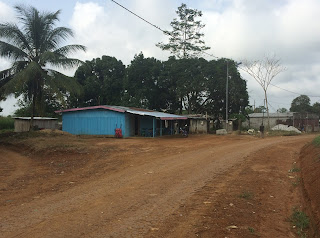
In this case I wanted to make a more modern building, still with a thatching grass roof, but with corrugated iron accessories.  This was based on a building I saw in Gabon, which now I look at it again had an all corrugated iron roof and the side-planks were vertical not horizontal.  No matter: 'tis but artistic licence.
Therefore, construction as noted was mainly from coffee stirrers braced with matches and cardboard.  The removable roof was made from bristles cut from an old brush stuck on to more cardboard and the veranda was roofed with bits of corrugated cardboard.
After undercoating inside and out in black, I basically dry-brushed the whole thing in various colours to get the effect I wanted.  Dark washes were used around the bottom of walls and in the shadows.  I have numerous tester pots of house paint lying about and to be honest they do just as well for this sort of work as anything.
The other building I did was meant to represent a collection of shanty houses.  This was made from thin polystyrene sheet (pizza packaging) and then covered in corrugated cardboard.
Again, dry-brushing in various colours was the order of the day, with an emphasis on giving things a rusty wash (I use Revell 37 Reddish Brown for that).
And as usual for the bases I textured these from my tub of coarse shelly sand and added various tufts of long grass in the corners.
Our glorious leader arrives in town, taking no chances
Anyway, that's it for now.  I'll have various other cardboard 'n' coffee stirrer construction projects to write about this year and, amazingly, a wargame AAR I've still to recount, so stay tuned.

Sunday, 8 December 2019

The Russians are Coming No.4

OK, last post about my newly painted 15mm early period Napoleonic Russians (until the next lot are ready, probably).  Just some generals and artillery.  There was a bit of a mix and match going on with these artillery units.  The guns are actually from Naismith (Navwar used to sell them) but the figures are either Warrior or Roundway. 
Warrior figures; Naismith guns (Russian 12lb)
I paired the Roundway crews with Naismith "Licornes", which I believe were a sort of cross between a cannon and a howitzer.  These have some odd zoomorphic handles on the top (i.e. they look like animals) and apparently Licorne is Russian for "unicorn". 
Roundway figures; Naismith guns (10lb Licornes)
I have four more guns (with crews) to paint and base and these will have Warrior cannons, which are noticeably larger than the Naismith guns.  And just to note that the Russian crew have black collars and cuffs piped in red.  To do these I painted the facings red and then over-painted in black to leave the piping along the edge.  Quite pleased with that which is why I mentioned it.
Warrior: Russian general
The generals are all Warrior and I apologise for the photos being a bit blurry/far away.  I like these figures as they're quite jaunty (well I think so).
Warrior: Russian general
This last one is actually a Warrior Prussian general (probably supposed to be Blücher) that I painted in Russian campaign dress.  Being a bit of a dull composition on his own I added a spare standard bearer (flag still to be added).
Warrior: Prussian/Russian general
Anyway, that's it for now you'll be relieved to learn.  I've a few more infantry regiments, artillery, dragoons and more cossacks to paint (one can never have enough cossacks), plus some (surprise!) German allies to supplement Geoff's French.  I expect I'll be busy over the Christmas holidays getting those done...

Tuesday, 3 December 2019

The Russians are Coming No.3

Having shown you my new 15mm Russian infantry I thought you may like to see the cavalry as well.  As with the infantry these are a mixture of Roundway and Warrior, mainly the latter.
Warrior - Don Cossacks
My favourite cavalry figures are the cossacks by Warrior, in their long blue kaftans and massive busbies.  I think they're really cool, so here's another photo of them.
Warrior - Don Cossacks again
In addition to these I painted two regiments of heavy cavalry, specifically the Emperor's Curassiers (blue facings) and the Ekaterinoslav Curassiers (orange facings).
Warrior - Emperor's Cuirassiers
Of course in this period Russian curassiers didn't actually wear the cuirass.
Warrior - Ekaterinoslav Cuirassiers
In addition to these I painted some dragoons, in this case the Kurland Dragoons.  These are Roundway figures and the helmets are a bit bulbous compared to the Warrior figures.
Roundway - Kurland Dragoons
I still have a few more regiments to paint include some Warrior dragoons and uhlans plus a few more cossacks.  One can never have too many cossacks I always think, particularly as the one thing I've always been short of on the table is light cavalry, especially cossacks.

Saturday, 23 November 2019

The Russians are Coming No.2

I've been meaning to post some pictures of the 15mm Russian Napoleonic army (pre-1812) that I have been working on this year but kept delaying because I was trying to get better pictures.  However, I've decided to go ahead and post this anyway because a) I don't have a decent camera b) the figures are actually quite small (being 15mm) and c) I'm not very good at taking pictures.
Roundway - Lithuanian Inspection, Murmansk and Rostov
As discussed in a slightly earlier post I decided to go for a mixture of Warrior figures with some Roundway.  They are pretty much compatible on the table although I generally didn't mix figures in the same regiment (exceptions apply, see below).  My intention was to have an early Russian army which means that regiments would still be organised into 'inspections' instead of divisions. 
Roundway - Lithuanian Inspection, Ekaterinoslav Grenadiers
This was party because I was using figures with earlier uniforms (especially Roundway) but also this meant I could paint different facings on the regiments, instead of them all just being red, as in later uniforms.  Furthermore, at that time the NCOs of different regiments carried halberds with different colour hafts (black, coffee or yellow) which applied to the drumsticks too.  Also, I don't like the kiwer much.

So, I started off with the Lithuania Inspection and painted them as the Murmansk & Rostov Musketeers and the Ekaterinoslav Grenadiers.  This worked fine until I realised that all of them would have the same flag, being similar to the green and white version that was adopted universally in the 1812 reforms (flags are all hand painted by the way).  So I decided to mix things up a bit going forward.
Warrior - Siberia Inspection, Tomsk regiment
And here are some examples including the Tomsk regiment (which naturally was chosen partly to honour a certain childrens' programme from the 1970s), and the Kazan regiment from the Caucasus Inspection.
Warrior - Caucasus Inspection, Kazan regiment
The idea was to get a variety of flags and facings and also, crucially, that the names of the inspections and/or regiments should be easily pronounceable for a non-Russian speaker like me.  Finally, I added the iconic Pavlov Grenadiers (flag still to be done).
Warrior - St Petersburg Inspection, Pavlov Grenadiers
Someone was telling me that the mitre continued in use in other grenadier regiments as well as the Pavlovs, but for now these will be the only guys sporting this impressive headgear on the tabletop.
Pavlovs advance purposefully
Having painted these I still have a few more infantry regiments to do (mainly Warrior) which will span various inspections and regiments including Kursk, Riga and my particular favourite the Astrakhan Grenadiers, which despite being from all the way over on the Caspian coast is, oddly, in the Moscow Inspection.
5th Jagers (turquoise facings)
To complete the infantry offering I also did some bases of Jagers.  At this time they wore uniforms of a paler green than the line regiments and sported rather natty top hats. The advancing figures are Roundway although the NCOs and officers are Warrior and as you can see they are a little more chunky.
6th Jagers (orange facings)
The drummer here is actually a spare musketeer with a modified shako.  I filed this down to be more cylindrical and added a brim at the back made from a sliver of plastic from a biro inner which was just the right radius.

For information (and so I won't forget when I come to paint the next batch) for the line regiments I used Tamiya JA Green (XF-13), which is the same colour I had previously painted some T-34 tanks.  For the Jagers I used Tamiya NATO Green (XF-67).

Finally, I would like to draw the reader's attention to the basing.  This was my usual coarse shelly sand painted earth brown then flocked.  However, for the Jagers I thought I'd do something different and have them advancing through broken ground, with the trees, stumps and fallen logs all being made from some dried cloves I found at the back of a kitchen cupboard; variety, as they say, being the spice of life.

Thursday, 17 October 2019

Stone Bridges

I'm not obsessed with bridges, no, it's just that I never seem to have enough of them, of the right kinds or periods.  So over the last few years there's been the Arnhem Bridge, an ancient period bridge, a couple of wooden bridges and an ACW period 'barn bridge' variant.

WSS Danes crossing a bridge
This time, for a planned wargame, I decided that I needed a new stone bridge.  So I built two of them, one intended for 15mm and the other for 20mm, because at the time I wasn't sure whether the game would be in 15mm or 20mm.  To do this I made a cardboard template for the sides which was used for both bridges.
Standard template
Construction comprised my usual pizza base polystyrene sheeting to form the sides.  The road surfaces (about 45mm wide for the 15mm bridge and 65mm for the 20mm bridge) were made from cardboard gently curved to shape, with wooden coffee stirrers glued underneath for strength and to provide more surface area for the PVA to key with when attaching the sides.  The buttresses were made from carved balsa or polystyrene.
Pointy
The second bridge used the same template, making both bridges the same length.  I did this because I've only got one width of river I'd made previously and also I didn't want the larger scale bridge to be too long and therefore take up too much space on the table.

The only difference was that I made the 20mm bridge at the larger scale with double the thickness of polystyrene walls.  The idea for this bridge was to make a representation of an eighteenth century bridge, based in fact on Wade's bridge at Aberfeldy in Perthshire.
Wade's Bridge at Aberfeldy
Bridges like this were constructed to link various of General Wade's roads across the Scottish Highlands, intended to enable swift movement of redcoats to subdue the Highlanders and to crush any inconvenient ideas they happened to have about not wanting to continue under Hanoverian/ British rule.
Pointy and painted
Anyway, to make this model more Aberfeldy-like I added some wooden trim to the sides and sharp pylons at each corner of the parapet, made from carved balsa.  I couldn't make the pylons as ridiculously high as the ones on the original bridge because they'd just get knocked off in storage or in action. 
Italeri French crossing a bridge
Once constructed everything was undercoated in black and then painted in a dark grey and dry-brushed with white.  Neither bridge has had an outing yet, but I think it likely that a future scenario from our One Hour Wargames campaign will include at least one substantial bridge, so look out for one or other of them.

Saturday, 12 October 2019

The Russians are Coming No.1

I've been planning a 15mm Russian Napoleonic army for some time, particularly as my regular opponent (Geoff) has various 15mm figures including French and Austrian, as seen in a number of One Hour Wargames AAR (see here and here).  Having never had a Russian army (I was always the French since our early Bruce Quarrie days) I thought this would be a good opportunity to try something new.  Also, green uniforms are cool.
15mm Warrior command on left, Roundway command on right
As Geoff's 15mm French are generally early period, I thought that matching Russians (i.e. pre-1812 reforms, no kiwers) would be best.  Having decided on a period I started looking for figures, and consequently I decided to do a comparison between suitable figures from Warrior, Roundway and Minifigs.
Warrior (L), Roundway (M) & Minifigs (R) 15mm Russians
A quick review of the infantry indicated that the Minifigs were not for me, being too skinny and for some reason cast in exceptionally light order (no packs).  What was interesting, however, was that the Roundway figures (grenadiers in this case, with massive busch) represent the 1805 uniform with the unreinforced shako and cylindrical valise carried diagonally across the back.  Nice.
Warrior (L), Roundway (M) & Minifigs (R) 15mm Russians - rear view
Meanwhile the Warrior figures are slightly later (1807-1809 reforms) with the reinforced shako and square backpack.  These figures are a bit stockier (and shorter) than the Roundway figures but do have a lot of character.
15mm Curassiers: Warrior (L) & Roundway (R)
As for the cavalry, the curassiers (and dragoons for that matter, because at that time Russian curassier regiments did not in fact wear cuirasses) are very similar.  Both figures have the 'caterpillar' type crest representing the pre-1812 period.  However, the helmet of the Roundway figure is oddly bulbous compared to the Warrior trooper.
Cossacks: Warrior (L), Roundway (R)
The cossack figures are really quite different, with the Warrior figure equipped with a sword and wearing a long kaftan and wide busby compared to the Roundway figures with lance.
Russian generals (Warrior)
Finally here are some Warrior Russian generals which are quite serviceable.

Overall, it came down to a toss-up between Roundway figures and Warrior.  I liked the early Russian infantry from Roundway with the valise instead of a backpack.  The Warrior cavalry I really liked, particularly the cossacks.  Overall, the Warrior figures are good and let's face it are considerably cheaper than Roundway, so they will form the bulk of the army.
Warrior RUS2 - true 15mm
Subsequent posts will show how my army has shaped up (with the addition of jaegers and artillery), and they might even feature in an AAR or two...

Friday, 23 August 2019

ACW Adventures in Basing No. 9

A very long time ago (2012 to be exact), I did a post featuring a box and some unpainted sprues of 1:72 Italeri ACW Union Cavalry, promising to get on with them ASAP.  The good news is that I have now finally finished and based them.
These are very nice figures and being a slightly stiffer type of plastic hold the paint very well.  It doesn't come out clearly in the photos but I painted these using a two stage tone system, i.e. after a thorough black undercoating I did the base coat colours (mainly from an old but trusty pot of Revell 5077 blue - which I use for painting Napoleonic French as well) and then some highlights with a slightly lighter blue.  It's the same system as I use for 15mm figures.
Faces were done using a 'rust' coloured base (Revell 37 Reddish Brown) and then flesh colour daubed in four places: on the cheeks, nose and chin.
Horses were initially painted in various shades of brown (e.g. Revell 85 Braun, and some in darker browns).  Thin black wash was then applied to each horse's face, manes, tail, legs and underparts in layers generally to build up the contrast and create variation across the animal.  Tackle was painted black afterwards.
Finally, I needed to upgrade my generals, which are very old plastic Spencer Smith figures (technically 40mm I think).  I stripped these down from their flat mid 1980s' paint job and removed the mould lines properly this time.  After painting, all figures were varnished using Windsor & Newton "Galeria" acrylic matt varnish, as recommended by a couple of people on the TMP forums.
Basing was my usually coarse shelly sand on MDF bases, with added static grass.  For some reason I never painted the sand on earlier ACW figures I'd based, so I kept with tradition on these ones.

So, remarkably, that's pretty much all of my ACW figures painted.  The only thing I might need is some dismounted replacements for the cavalry, but they feature so rarely in our games (when we have ACW games) that they're not even on my list of things to do.

Monday, 12 August 2019

Claymore 2019

Just over a week ago now and here is my belated report on Claymore 2019.  It's great having a wargame show in Edinburgh that we don't have to travel too far to get to and most years it is pretty good with some interesting games and ideas on display.
I'm sure everything will be fine.


This year was a bit lack-lustre for some reason, I'm not sure why. There were a few empty tables meaning some expected groups just hadn't turned up, which was odd.  The traders were mostly there however, although I don't know how busy they were.  Anyway, here are some of the notable games that were on.
Up the Nile
The Iron Brigade's "Up the Nile" scenario (using the Partizan Press rules of the same name) concerned "a ripping yarn set in the sweltering head of the Sudan" (it says here), looked really nice and the buildings were great.  I'm not sure how those lads wading past our old friends the Nile crocodile (Crocodylus niloticus) got on, however. 
View from the other end of the table
Just to add that I've been to the upper Nile (Lake Albert area) myself half a dozen times and admit I've never seen one.  Mind you, if I'd fallen off the Paraa ferry I expect they'd have turned up sharpish.
Pucharas in the mist (I'm gonna put a hex on you)
Another interesting game was a Falklands War public participation effort with the SAS attacking an Argentine airstrip (Pebble Island).  Pucharas are instantly recognisable, as are the typical tin sheds down there.
Naval gazing
There was also a really nice age of sail game set up by the Border Reivers.  Ships were 1/600 scale paper and wire efforts available as pdf downloads from War Artisan. They looked fantastic and after this I am seriously thinking of getting a few of them.
What shores?
The coastal terrain was also great with some scratch built buildings and various harbour pieces (and jolly boats) by Peter Pig.  Other games that caught my eye included:
  • An interesting 15mm forest clash between the Finns and the Russians, with some nice figures and terrain (Gourock Wargames Association);
Can't see the wood for the trees
  • A very long (about 5m long in fact) Vietnam convoy type game (SPIT Wargames);
Hue's that coming down the road?
  • A rather nice 10mm depiction of the battle of Gitchen from the 1866 Austro-Prussian War (SESWC); and
Sun-dappled fields of death
  • An Ottomans vs Imperials display (League of Augsberg) with a very impressive mortar firing off in the centre.
I seem to remember Baron von Munchausen riding one of those
Finally, apart from a few pre-cut bases, I actually bought something: some very useful looking 15mm African/Afghan buildings for my AK47 side-project, from those nice people at Pendraken/Minibits.
I love the smell of laser-cut MDF in the morning